
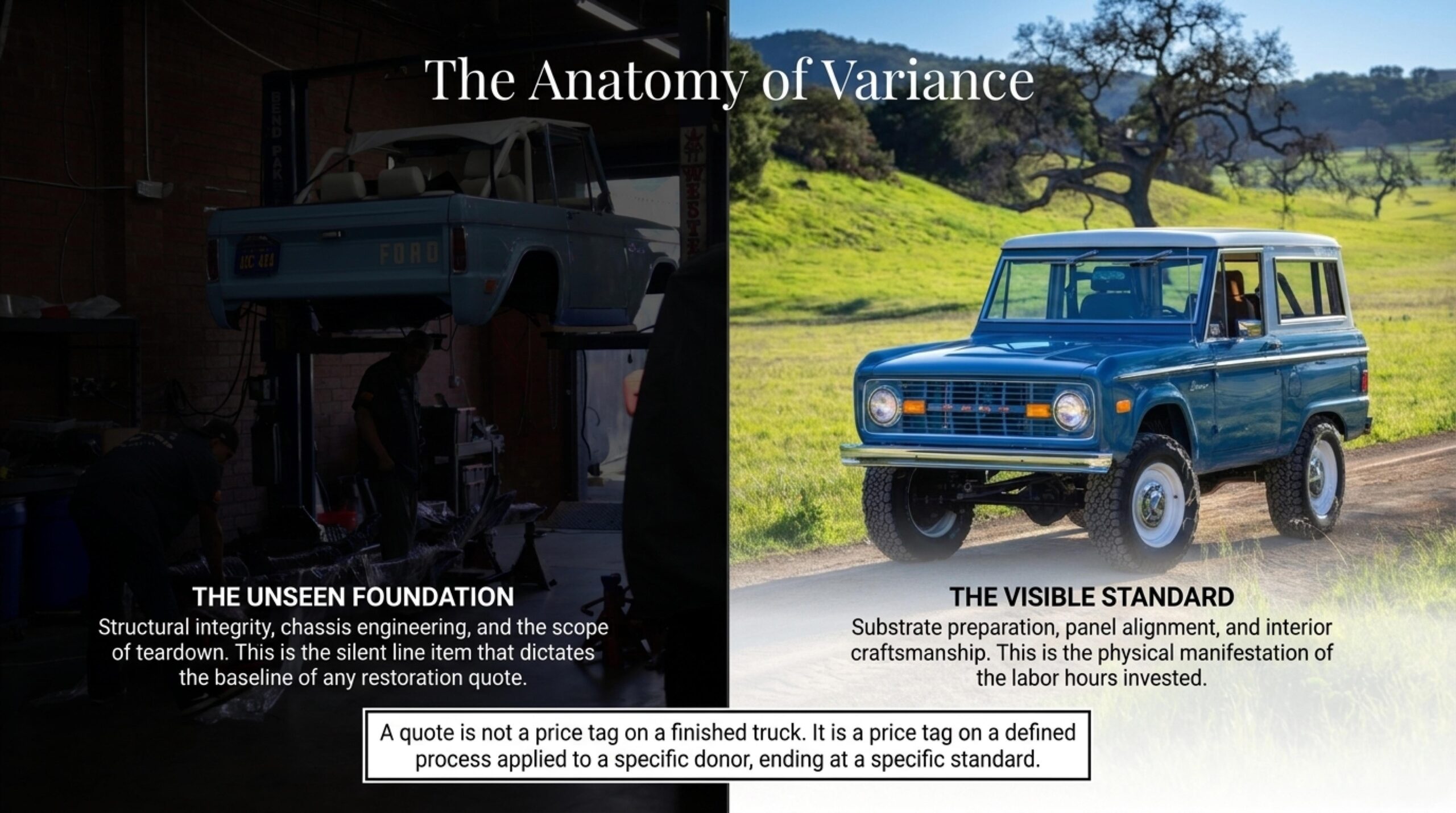
If you’ve gathered more than one quote on a 1966–1977 Bronco build, you already know the puzzle: two shops describe what sounds like the same truck, yet the numbers feel like they belong to different industries. That gap is not a mystery. The Early Bronco restoration cost you’re being quoted is a precise reflection of scope, standards, and depth — three variables that the trade has never standardized. Once you can read those variables, the variance stops looking arbitrary and starts looking like information. This guide is written to make you a better buyer of an Early Bronco restoration, not to anchor you on a number that will be obsolete by next quarter. We won’t quote figures here on purpose. What we will do is walk you through every lever that moves the Early Bronco restoration cost so you can compare apples to apples.
Across the 1966–1977 production window, no two surviving Broncos are identical. Rust patterns, prior repairs, drivetrain swaps, and decades of weather create a starting point that is unique to each VIN. That’s the first reason the Early Bronco restoration cost spreads so wide.
What “Early Bronco restoration cost” actually measures
A restoration quote is not a price tag on a finished truck. It’s a price tag on a defined process applied to a specific donor, ending at a specific standard. Change any one of those three — process, donor, standard — and the Early Bronco restoration cost changes with it. A useful Early Bronco restoration cost conversation begins by separating those three layers and asking, in writing, what’s included in each.
A complete build can span from five figures into six figures depending on scope. That isn’t evasion; it’s the honest envelope. Hagerty has documented similar variance across restoration tiers — driver, show, and concours-level work are fundamentally different projects (Hagerty: levels of restoration).
The donor truck: where every quote really begins
The condition tier of the donor is the single largest swing variable. A solid Western truck with clean inner structure is a different project than a Northeast survivor with hidden rust in the frame rails, floor pans, inner fenders, and rear quarters. Buyers are often surprised that the bill of materials for metalwork can rival the bill for paint or drivetrain on a heavily corroded donor. Hagerty’s rust-repair primer makes the same point in general terms (Hagerty: rust repair basics).
If a shop quotes you without inspecting the truck, what you’re getting is a placeholder, not a scope. A real estimate begins after teardown reveals what’s actually there.
Frame treatment depth — the silent line item
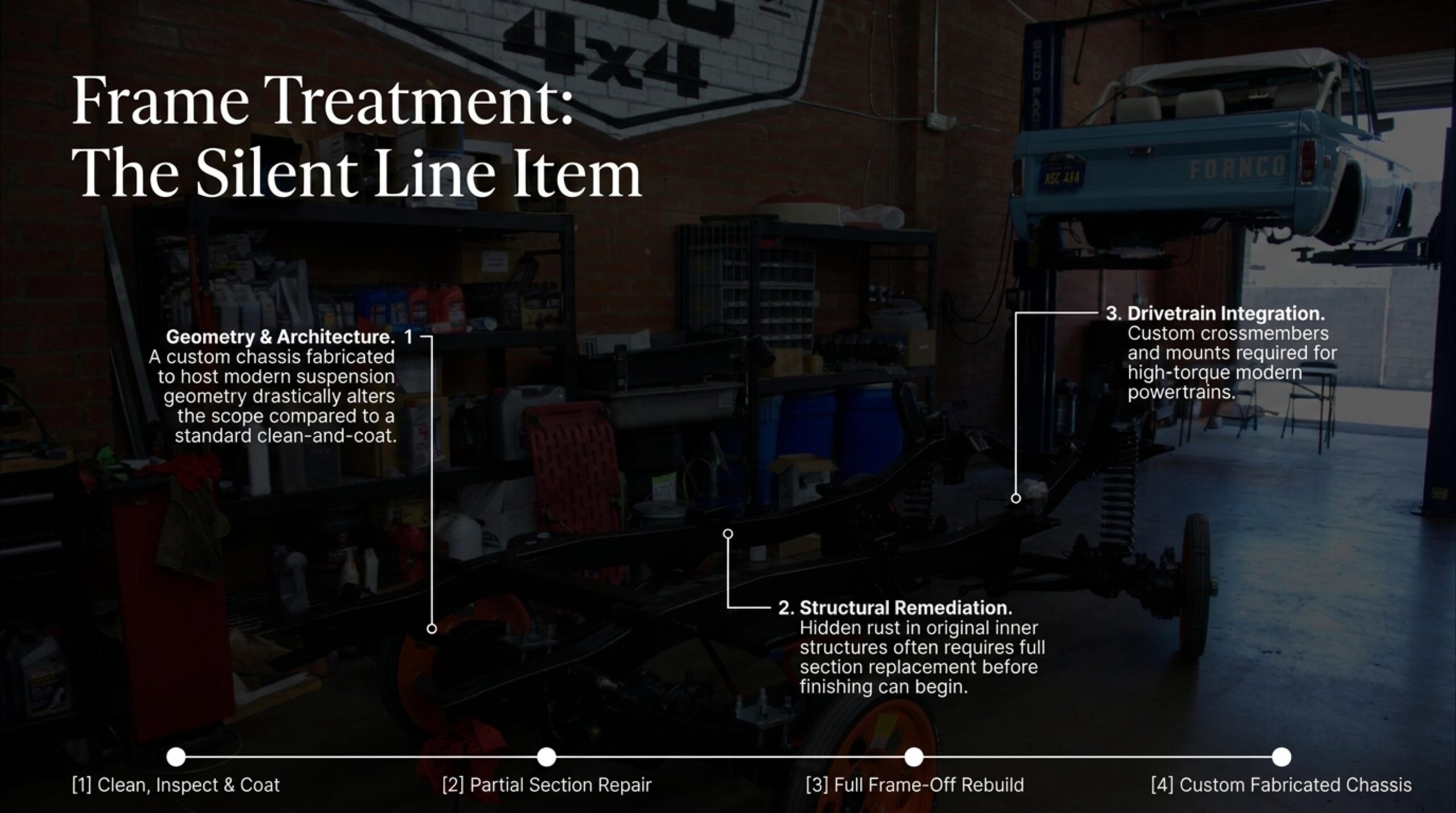
“Frame-off” is a phrase that hides a spectrum. On one end, the frame is cleaned, inspected, and coated. In the middle, sections are cut out and replaced with new steel. On the far end, a custom chassis is fabricated to host a modern drivetrain, suspension, and brake package. Each of those represents a different project, different labor hours, and a different result when you turn the key. Buyers comparing quotes should always ask which of those four treatments a shop is proposing.
Body, panel gaps, and paint preparation standards
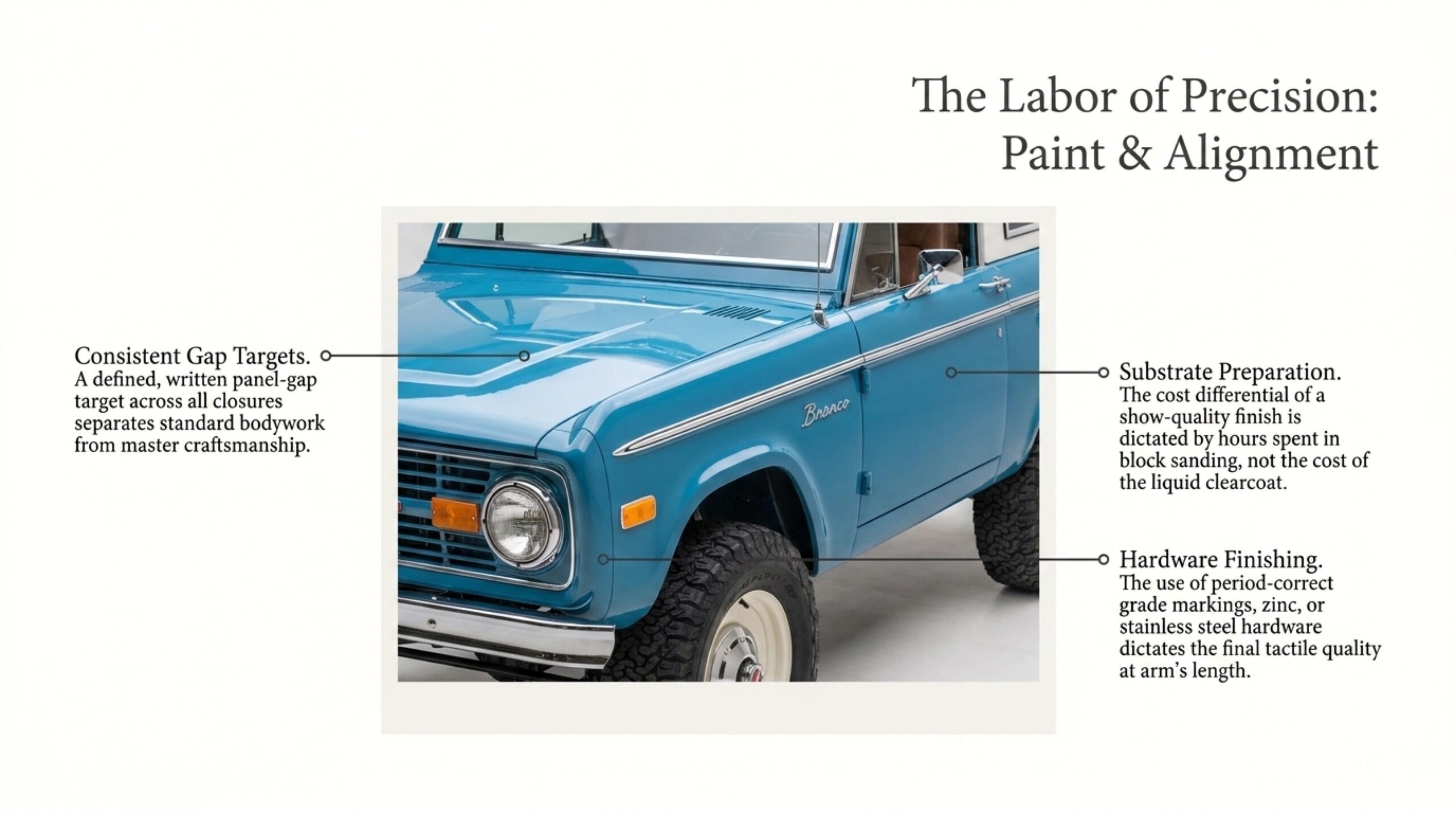
Paint is where standards become visible. The cost differential between a respectable driver-quality finish and a show-quality finish is almost entirely labor in block sanding, panel alignment, and substrate preparation — not the paint itself (Hagerty: what makes a good paint job).
A written panel-gap target is one of the cleanest ways to compare two shops. If one quote specifies a consistent target across doors, hood, and tailgate, and the other does not specify at all, you are not comparing equivalent work — even if the line items look similar.
Drivetrain philosophy: period-correct, modern V8, diesel, or EV
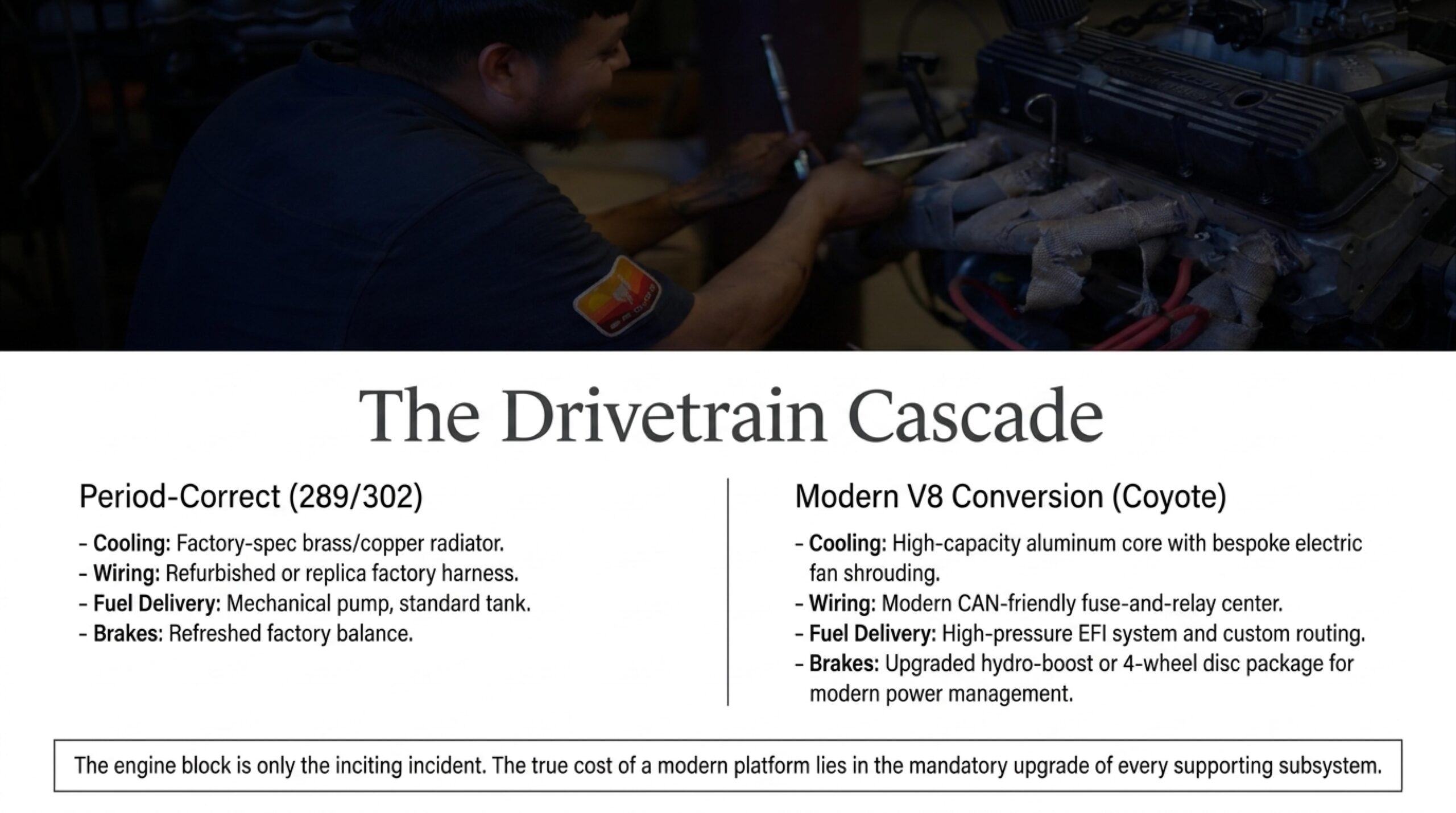
The drivetrain platform you choose cascades into nearly every other system. A period-correct 289 or 302 rebuild with a refreshed transmission and transfer case is a different scope than a modern fuel-injected V8 conversion, which is different again from a diesel conversion or an electric powertrain. Each path implies its own mounts, crossmembers, cooling, fuel delivery, wiring, brake balance, tuning, and emissions considerations.
There is no “right” answer here — only the right answer for how the buyer intends to use the truck. Defining intent up front is what keeps an Early Bronco restoration cost conversation honest.
Suspension, brakes, and how the truck is meant to be driven
A weekend cruiser, a weekly driver, a backcountry trail rig, and a long-distance touring build are four different suspension geometries, four different brake packages, and four different tire-and-wheel decisions. Quotes that don’t reflect a clear use case usually compress to the same midpoint regardless of buyer intent — which means the cheaper one isn’t a deal, and the more expensive one isn’t a markup. They’re describing different trucks.
Interior, electrical, and hardware standards
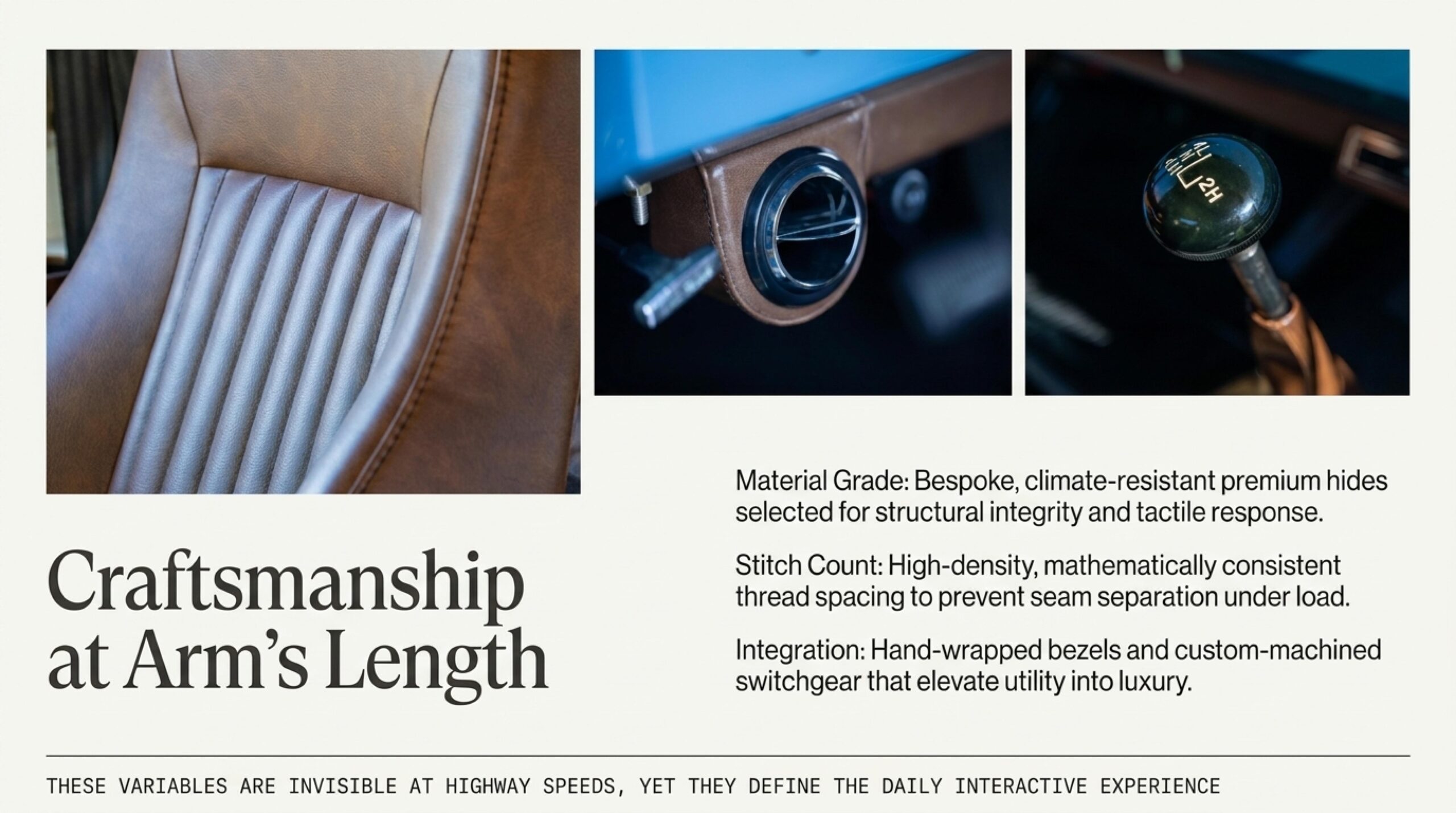
Interior material grade, stitch count, headliner construction, and dash treatment are all variables on a sliding scale. So is electrical architecture: a refurbished factory harness is one project; a modern fuse-and-relay center with CAN-friendly accessories is another. Even hardware finish — zinc, black oxide, stainless, period-correct grade markings — separates a thoughtful build from a rushed one.
These details are invisible at twenty feet and decisive at arm’s length. They are where craftsmanship lives.
Documentation, warranty, and the part you can’t see
Documentation is not paperwork — it’s proof of process. A build book with photo documentation at each stage, parts receipts, alignment specs, and torque records is a deliverable in its own right. So is the warranty. Warranty term, what it covers, and how claims are handled vary widely across the trade and should be agreed in writing before any deposit changes hands.
Decision guide: how to read your own quote
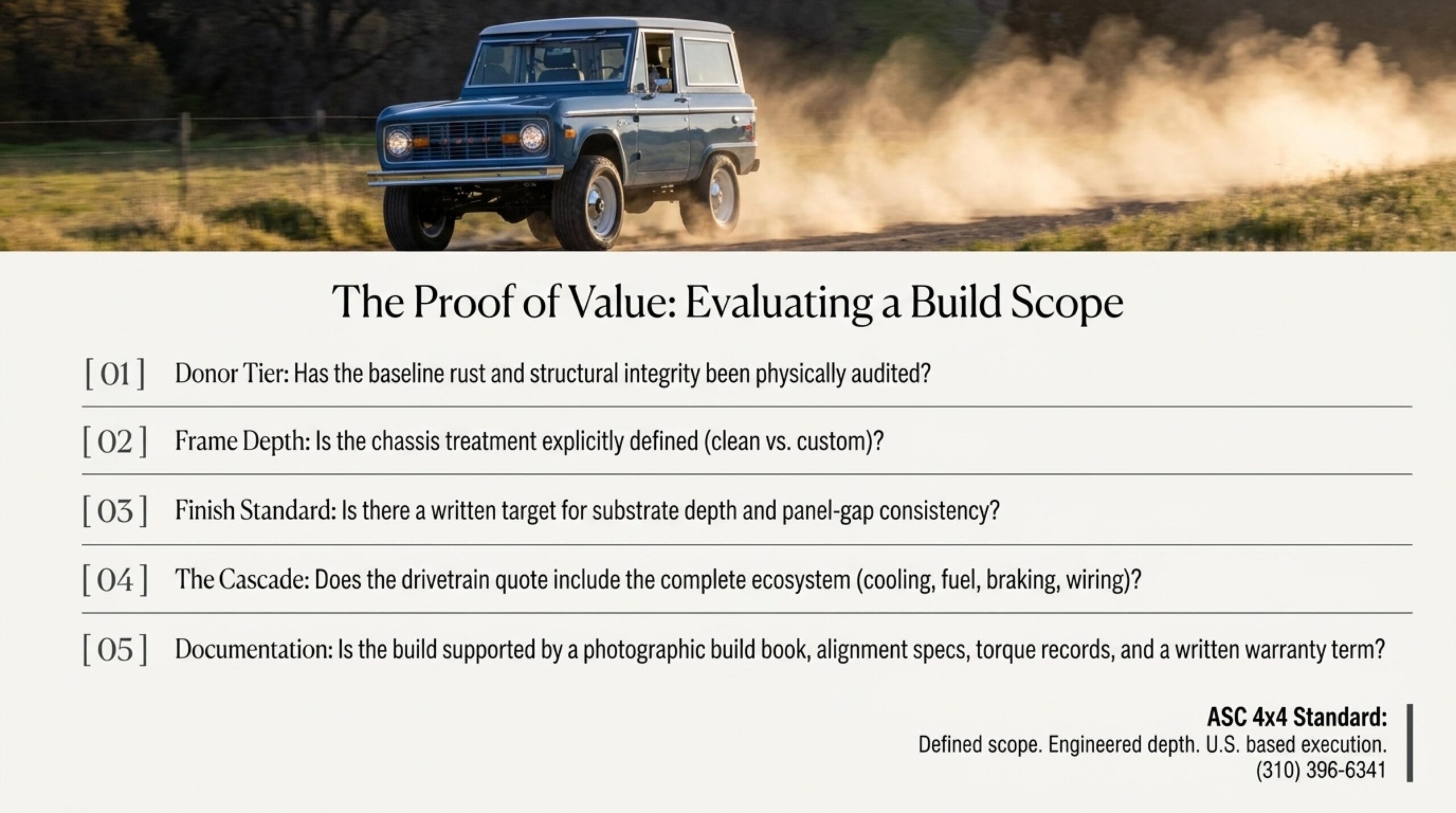
Before you sign anything, run your quote through these five questions:
- Donor condition tier — has the shop physically inspected the truck and documented findings?
- Frame treatment depth — clean and coat, repair, replace, or custom chassis?
- Panel-gap and paint standard — is a target specified in writing?
- Drivetrain platform — is the full cascade (cooling, fuel, wiring, brakes) included or itemized as TBD?
- Warranty and documentation — what’s the term, what does it cover, and what will you receive at delivery?
If a quote can’t answer those five clearly, the number on the bottom line is provisional.
How ASC 4×4 scopes a build
Based in Southern California and serving clients across the country, ASC 4×4 works only on Early Broncos from the 1966–1977 production window. Every project begins with a written scope tied to your intended use, the donor’s actual condition, and the standards you want held — panel gaps, finish depth, drivetrain platform, suspension philosophy, interior grade, electrical architecture, hardware spec, documentation, and warranty term. We don’t publish menu pricing because we don’t build menu trucks. The Early Bronco restoration cost for your build will reflect your truck, your standard, and your use case — nothing else.
For a tailored scope conversation and a current quote on a 1966–1977 Bronco, call, email, or use the contact form on our site. Out-of-state and remote clients are routine; logistics are part of the scope.
FAQ
What does Early Bronco restoration cost typically include? A defined scope-of-work tied to a specific donor, ending at a specific standard. The honest envelope can span from five figures into six figures depending on depth, drivetrain platform, and finish standard. The only meaningful Early Bronco restoration cost is the one written against your truck and your standards.
Is a frame-off restoration always required? No. It depends on the donor’s condition and the buyer’s intended use. A solid driver-quality refresh is a legitimate project; so is a full frame-off rebuild. The right answer is the one that matches your standard.
How long does a build take? Comprehensive builds commonly run well over a year. Timelines compressed below that usually signal compressed scope — which is a legitimate choice, but it should be a transparent one (Hagerty: how long restorations take).
Period-correct or modern drivetrain — how do I decide? Start with intended use. Weekend nostalgia, daily-drivability, towing, long-distance touring, and zero-emission city use all point to different platforms. We can walk you through trade-offs before scope is written.
How do I compare two quotes that look very different? Normalize the scope. Ask each shop to specify donor condition tier, frame treatment depth, panel-gap target, drivetrain cascade, warranty term, and documentation deliverables. Most of the variance disappears once those are aligned.
Do you offer a warranty? Yes. Term and coverage are written into your build agreement before deposit.
Can ASC 4×4 work with out-of-state clients? Yes. We’re based in Southern California and routinely build for clients across the country. Logistics and remote communication are part of how we scope.
Why don’t you publish prices? Because publishing numbers without scope misleads buyers. The point of this guide is to make you fluent in the variables that actually drive an Early Bronco restoration cost so the conversation we have together is precise.
asc4x4.com | (310) 396-6341
Additional Reading
Buying a Finished Early Bronco vs Commissioning a Build: A Serious Buyer’s Decision Framework
The Best Bronco Restoration Company: How to Actually Choose One
Restomod vs Restoration: Which Path Is Right for Your Early Bronco Build?
Sources
The Different Level of Restoration Explained (Hagerty)
How Does Drivetrain Choice Change the Build? (Ford Authority)