
 For the serious enthusiast, the path into a 1966–1977 Ford Bronco usually narrows to a single question: are you buying a finished Early Bronco that’s already been brought to standard, or are you commissioning a build authored to your specification? Both paths lead to a truck you can be proud to own for decades. Neither is the “right” answer in the abstract — the right answer is the one that fits your timeline, your tolerance for scope decisions, your use case, and the way you intend to live with the vehicle. This guide is a no-hype decision framework for buyers weighing buying a finished Early Bronco against commissioning a bespoke build, written from the perspective of a shop that does both.
Buying a finished Early Bronco is, in the cleanest cases, a transaction: you inspect, you negotiate, you take delivery. Commissioning is a relationship: you co-author scope, you make hundreds of small decisions, and you watch a truck come together over many months. Understanding the difference at that level — transaction vs authorship — is what separates buyers who are happy two years in from buyers who wish they’d chosen the other path.
Why the Buy-vs-Commission Question Matters for 1966–1977 Broncos

The Early Bronco platform — the original 1966 through 1977 generation — occupies a unique place in the collector and enthusiast market. Supply of original, unmolested examples is finite and shrinking; demand for properly restored and thoughtfully upgraded trucks is sustained. Public auction results across reputable platforms make clear that quality, documentation, and scope discipline are what hold value over time, not badging or paint color choices alone (Hagerty Valuation Tools).
That dynamic shapes both paths. Buying a finished Early Bronco compresses time and removes uncertainty about the end state. Commissioning gives you control over every choice that defines the end state. Each has costs the other doesn’t.
Buying a Finished Early Bronco: What You’re Really Acquiring

When buying a finished Early Bronco, you are acquiring three things at once: a vehicle, a documented build history, and the judgment of whoever specified the original scope. The first is inspectable. The second should be inspectable. The third is inherited — and it’s the one most often underweighted.
A truly finished truck should arrive with a build journal, photo documentation of the frame-out phases, parts receipts where relevant, a chassis and drivetrain spec sheet, and a clear statement of what was and was not addressed. Buyers who skip this documentation step are buying a paint job, not a restoration. Hagerty’s buying guidance repeatedly emphasizes documentation as the single most useful filter (Hagerty buying and selling).
The advantages of buying a finished Early Bronco are real and significant:
- Time compression. You can be driving the truck this month rather than next year.
- Known cost. The number on the invoice is the number; scope creep has already happened (or hasn’t, and isn’t your problem to manage).
- Inspectable result. You can drive it, hear it, smell it, and look underneath before committing.
- Market liquidity. A documented, finished 1966–1977 Bronco has a clear comparable set in public auction results.
The trade-off is authorship. Someone else decided the gearing, the seat material, the wheel and tire package, the paint code, the engine choice, the interior layout. If those decisions align with how you intend to use the truck, buying a finished Early Bronco is the most efficient path to ownership. If they don’t, you’ll spend years quietly re-doing pieces.
Commissioning a Build: What You’re Really Authoring
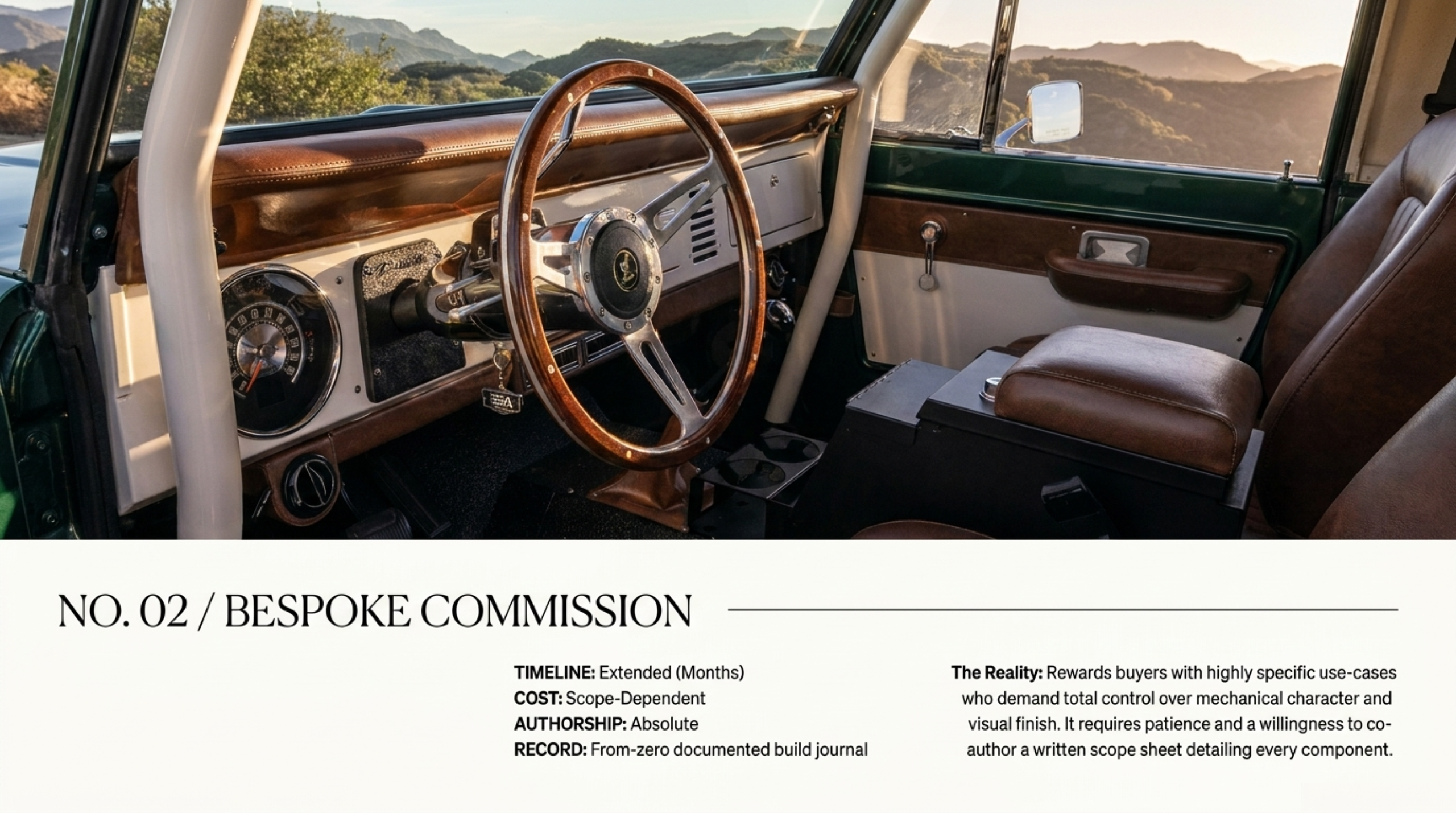
Commissioning is the opposite trade. You give up time and the certainty of a fixed delivery date in exchange for control over every meaningful decision. A properly run commission begins with a scope conversation: how will you use this truck, where will you drive it, what climates, what passengers, what aesthetic, what mechanical character.
From that conversation comes a written scope sheet covering chassis approach, drivetrain selection, suspension geometry, brake system, steering, interior, electrical, paint and body, and a delivery target. The buyer reviews and signs. The build proceeds against that document, with change orders for any deviation.
Commissioning rewards buyers who:
- Have a specific use case in mind that doesn’t match what’s commonly available finished.
- Care about authorship and want a truck that reflects their judgment.
- Are comfortable with a longer timeline in exchange for specificity.
- Want a documented, from-zero build history attached to the VIN.
It is not the right path for buyers who need a truck soon, who don’t want to make hundreds of small decisions, or who would rather inherit a well-considered spec than originate one.
The Hybrid Path: Partial Restorations and In-Progress Trucks
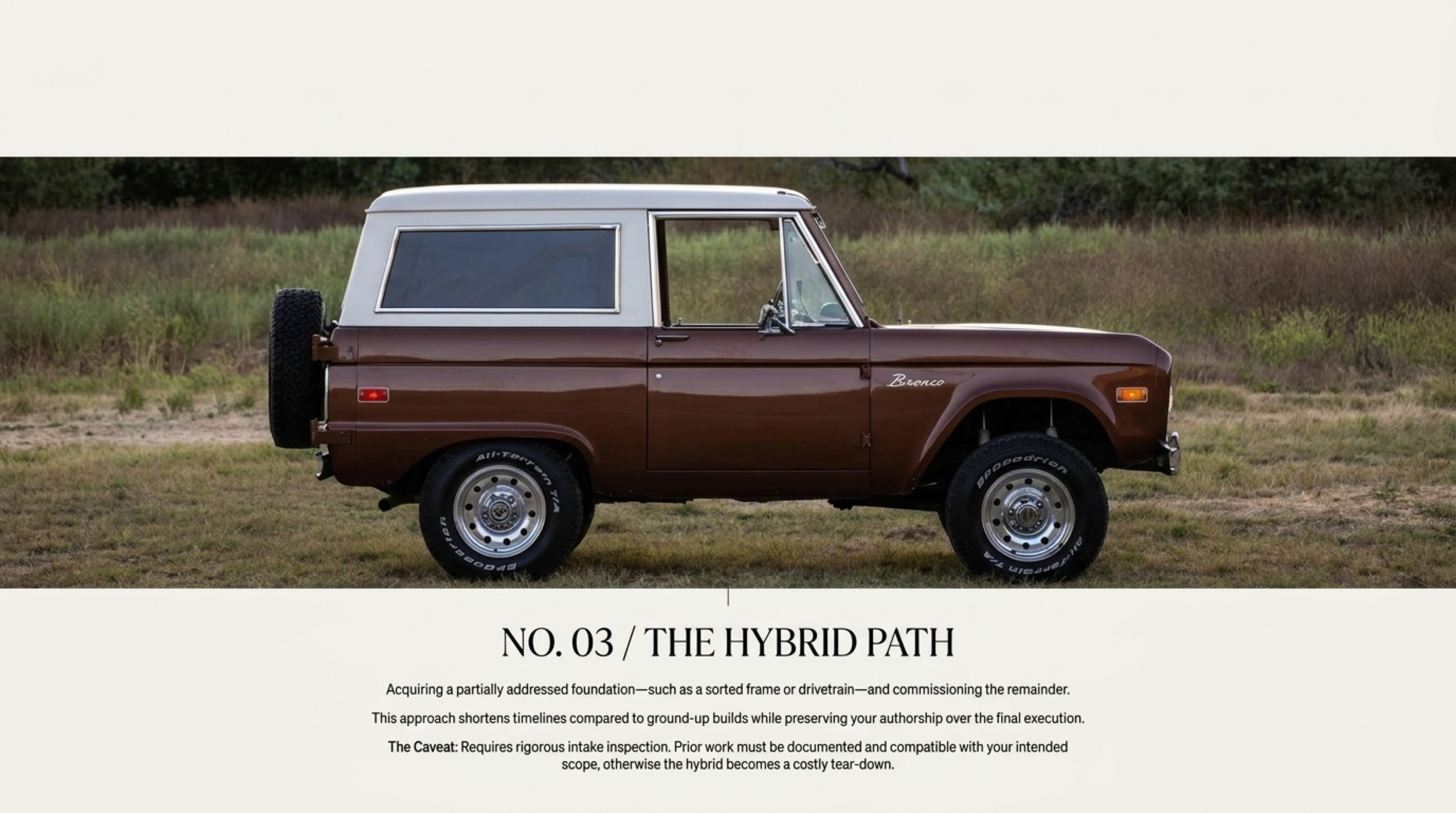
There is a middle path that often goes underdiscussed: acquiring a 1966–1977 Bronco that has been partially addressed — frame, drivetrain, or body sorted — and commissioning the remainder. This hybrid approach can shorten timelines compared to a ground-up commission while preserving authorship over the pieces that matter most to the buyer.
The hybrid path requires careful intake. The work already done has to be inspectable, documented, and compatible with the buyer’s intended scope. When it works, it works very well. When the prior work is undocumented or poorly executed, the hybrid becomes a tear-down, which is usually slower and more expensive than starting clean.
Decision Guide: Finished vs Commission vs Hybrid

A practical filter:
- Choose buying a finished Early Bronco when: Your timeline is short, you’ve found a truck whose spec aligns with your use case, the documentation is complete, and a third-party inspection confirms the build quality.
- Choose commissioning when: Your use case is specific, you want authorship over the spec, your timeline is flexible, and you value the relationship and journal that come with a from-zero build.
- Choose hybrid when: A partially completed 1966–1977 Bronco exists whose finished portions you’d authorize anyway, and the remaining scope is something you want to author.
None of these paths is “better.” They are different products with different ownership experiences.
Inspection, Provenance, and Documentation Standards

Whichever path you choose, the standards are the same: VIN, body tag, and provenance must match and decode correctly (Ford VIN decoding resource); the build history should be photographic and itemized; mechanical condition should be verified cold and hot; and the undercarriage tells the truth that paint hides. Forum discussions consistently emphasize undercarriage and cold-start inspection as the most reliable filters, though those are anecdotal community standards rather than industry rules (classicbroncos.com forums).
For finished trucks, insist on documentation before you fly to see the vehicle. For commissions, insist on documentation as a deliverable of the build itself.
Time, Scope, and Lifestyle Fit

The most overlooked variable is lifestyle fit. A weekend cruiser on the coast, an overland-capable truck for inland trips, and a show-grade garage queen are three different vehicles. Buying a finished Early Bronco that was built for one use case and asking it to serve another is a quiet form of mismatch. Commissioning lets you specify that fit explicitly.
We work primarily out of Southern California and ship and coordinate nationally; many of our commissions are delivered to buyers we never meet in person until handoff.

Ownership Horizon and Long-Term Care
A 1966–1977 Bronco is not a disposable purchase. Plan for the ownership horizon at the time of acquisition: who services it, how often, where parts come from, and what the long-term care cadence looks like. Buying a finished Early Bronco from a shop that supports the truck after delivery is materially different from buying one from a private seller with no continuing relationship.

Common Mistakes Serious Buyers Make
- Treating cosmetic finish as evidence of mechanical integrity.
- Skipping documentation review when buying a finished Early Bronco.
- Under-scoping a commission and absorbing the change orders later.
- Confusing show-grade choices with drivability choices.
- Ignoring the cost and time of post-purchase modification when the inherited spec doesn’t fit the use case.

The ASC 4×4 Standard and How We Quote
Our standard on both paths is the same: frame-out discipline, documented build journals, drivability prioritized alongside aesthetics, transparent scope sheets, and a post-delivery support cadence. We quote commissions against scope variables — chassis approach, drivetrain selection, suspension and brake spec, interior level, paint and body scope, electrical scope, and delivery timeline — not against guessed numbers. For finished trucks, we evaluate against the same scope variables in reverse.
For pricing on a specific build or a specific finished truck, call, email, or use the contact form. Quotes are built on your scope, not on a menu.

FAQs
Is buying a finished Early Bronco faster than commissioning one? Yes, materially. Buying a finished Early Bronco can put you in the driver’s seat within weeks; a commission is measured in many months from contract to delivery. The trade is authorship — a commission lets you specify every decision; a finished truck inherits someone else’s.
How do I verify the quality of a finished Early Bronco before purchase? Require documentation: build journal, photo record, parts list, and spec sheet. Inspect cold and hot. Inspect the undercarriage. Verify VIN and body tag. If any of those are unavailable or evasive, treat that as the answer.
Can a finished Early Bronco be modified after I take delivery? Yes, and many owners do. The question is whether the inherited spec is close enough to your use case that modifications are refinements rather than re-builds.
What documentation should I expect with a finished 1966–1977 Bronco? A written scope sheet, a photographic build record, parts documentation, VIN and body tag verification, and a clear statement of what was and was not addressed.
How long does a commissioned Early Bronco build typically take? Many months from contract to delivery, depending on scope. Specificity in scope shortens the build; ambiguity lengthens it.
Do you work with remote buyers outside Southern California? Yes. We’re based in Southern California and routinely coordinate with buyers nationally, including delivery logistics.
How does ASC 4×4 quote a build or evaluate a finished truck? Against scope variables — chassis, drivetrain, suspension, brakes, interior, paint and body, electrical, and timeline — rather than against a menu. Reach out for a scoped conversation.
asc4x4.com | (310) 396-6341
Additional Reading
The Best Bronco Restoration Company: How to Actually Choose One
Restomod vs Restoration: Which Path Is Right for Your Early Bronco Build?
302 vs 351W vs Coyote 5.0: Choosing the Right Engine for Your Early Bronco