
The engine shapes the character of an Early Bronco, but the best choice depends on the whole vehicle and how you want to use it. A traditional Ford 302 or 351 Windsor can suit an original-style build; a modern Coyote 5.0 offers a different combination of technology and performance.
When comparing engines, look beyond a headline horsepower figure. Intended use, fitment, transmission, gearing, cooling, fuel delivery, electronics and the condition of the starting vehicle all affect the finished build.
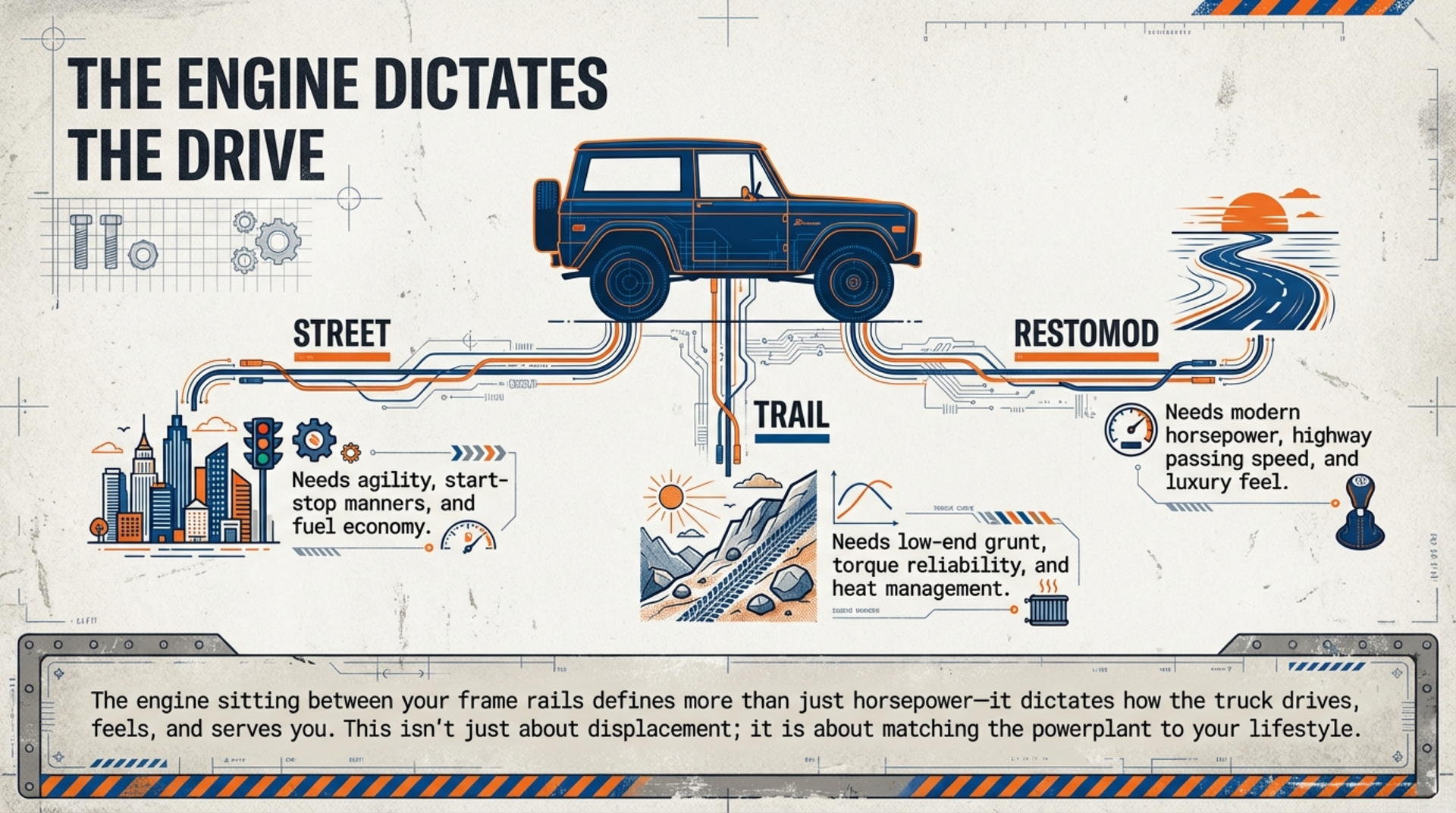
Understanding the Three Engine Families
302 Windsor: A familiar small-block Ford V8 with traditional pushrod architecture. It can appeal to an owner who values an original-style engine bay and a straightforward driving character. Condition and the specific build matter more than a generic power claim.
351 Windsor: A larger-displacement member of Ford’s Windsor family. It can be a useful choice when an owner wants a traditional V8 with a different performance character. Height, accessory placement, hood clearance, engine mounts and transmission compatibility must be checked for the particular parts and vehicle.
Coyote 5.0: Ford’s modern dual-overhead-cam V8 family brings electronic engine management and modern fuel injection. Generations and applications differ, so confirm the exact engine and its specifications rather than assuming one output applies to every Coyote.
Plan the Whole Powertrain
Engine choice affects more than the engine bay. Review the transmission and transfer case, mounts, cooling, fuel system, exhaust, wiring, engine controls, accessories and clearance together. Brakes, suspension and gearing should suit the intended vehicle and use.
Conversion packages differ by supplier. Ask for an itemized list of what is included, what must be sourced separately, the compatible transmission options, installation work and any vehicle-specific fabrication. Do not assume an engine package includes a transmission or a complete ready-to-drive conversion.
If you are planning a complete or substantial partial restoration, talk with ASC about your driving goals and powertrain priorities.
Driving Character, Reliability and Use
Consider where the truck will spend its time: city streets, highway travel, trails or a mix. Torque delivery, gearing, tire size and vehicle weight all shape how it feels. The condition, tuning, installation and maintenance of the complete system matter for reliability; none of these engine families guarantees a particular result.
For trail use or towing, plan the vehicle as a system. Chassis condition, brakes, tires, cooling, axle gearing, hitch equipment and applicable vehicle ratings matter alongside the engine. An engine swap does not by itself establish a towing capacity.
Fuel economy and range depend on the completed vehicle, its gearing, tires, weight, tuning and driving conditions. Figures from a modern donor vehicle should not be treated as an Early Bronco estimate.
Investment and Build Scope
ASC’s complete custom builds generally range from $100,000–$250,000+, depending on the starting vehicle, agreed scope and specifications. A donor vehicle is required; ASC can discuss sourcing one. Substantial partial restorations are evaluated individually, and the complete-build range is not a quote for an individual engine or partial project.
When comparing proposals, look for what is included in the engine, transmission, parts, labor, fabrication, integration and testing. Confirm how unforeseen work and changes will be documented before making a decision.