
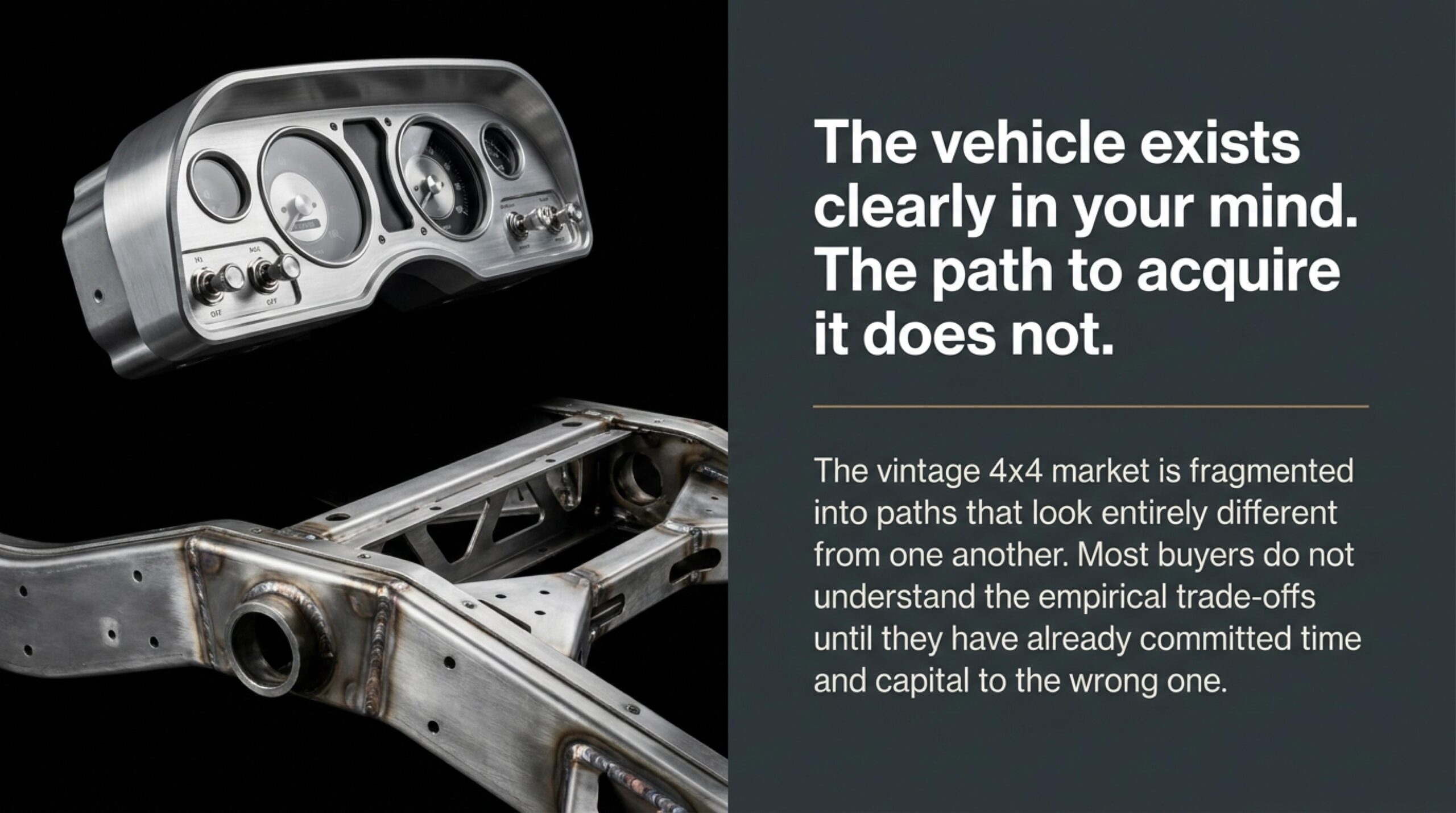
You want a vintage 4×4. Maybe it’s an Early Bronco. Maybe it’s a Scout, a classic Defender, or a Land Cruiser. The vehicle is clear in your head — the color, the stance, the way it sounds at idle. What’s less clear is how to actually get it. That’s what our vintage 4×4 buyer’s guide will teach you!
Deciding on an acquisition path is where most people get stuck. Not because trucks don’t exist on the market, but because the paths to ownership look very different from each other — and most buyers don’t understand the real trade-offs until they’ve already committed time and money to the wrong one.
This vintage 4×4 buyer’s guide breaks down every acquisition path available to you: buying ready-to-drive from an auction, dealer, or private seller; buying a rough project and tackling it yourself; handing a truck to a professional shop; or commissioning a build using an assessed starting vehicle. Each path has a different cost structure, a different risk profile, and a different outcome. The goal here isn’t to tell you what to do. It’s to make sure you understand what you’re choosing before you choose it.
Four Paths to Vintage 4×4 Ownership
Each path has different costs, timelines, and trade-offs. Compare the actual vehicle and written scope before committing:
| Path | What to consider |
|---|---|
| Buy a finished vehicle | Inspect the specific truck, its documentation, and any work it may need. |
| Restore a project yourself | Account for your time, skills, facilities, parts, and outside specialist work. |
| Commission a restoration on your vehicle | Discuss starting condition, scope, budget, and expected timing with the builder. |
| Commission a build with a sourced donor | Review the proposed donor, its condition, and how acquisition is handled in the written quote. |
Every path can get you a truck. Not every path gets you the truck you actually want at the price you expected on the timeline you need.
Path 1 — Buy Ready to Drive
This is the most intuitive path: find a vintage 4×4 that’s already restored or in solid running condition, pay for it, drive it home. Three channels exist for this.
Auctions (Online and Live)
Platforms like Bring a Trailer have transformed the vintage vehicle market. Online auctions offer broad selection, transparent bidding history, and community commentary that helps surface both quality builds and red flags. Live auctions — Mecum, Barrett-Jackson, and regional events — offer the experience of seeing trucks in person before bidding.
What works: You can see a wide range of vehicles quickly. Bidding histories on platforms like BaT give you real market data. Community comments often catch issues the seller didn’t disclose. For trucks with documented build histories from reputable shops, auctions are an efficient marketplace.
What doesn’t: Auction vehicles are sold as-is. Buyer’s premiums and other fees can add to the hammer price. Online listings can obscure condition issues — professional photography makes everything look better than it is. The competitive bidding environment creates emotional pressure that leads to overpaying. And the biggest issue: you’re limited to what’s listed. If you have a specific vision — a particular color, drivetrain, interior spec — you may wait months or years without finding it.
The hidden cost: Deferred maintenance. A truck that runs and drives may still need work that was deferred or not visible in listing photos. Budget for an inspection and any work the vehicle may need.
Dealers and Classic Car Lots
Classic vehicle dealers curate inventory, handle paperwork, and provide some level of accountability that private sales and auctions lack. Specialty dealers who focus on specific marques — Broncos, Land Cruisers, Scouts — typically have deeper knowledge and more relevant inventory than general classic car lots.
What works: Dealers may help handle title, registration, and financing logistics. Reputable dealers stake their reputation on the vehicles they sell. Some offer limited warranties or return policies. You can inspect in person, test drive, and ask detailed questions with a reasonable expectation of honest answers. For buyers who value convenience and risk reduction, dealers offer a streamlined path.
What doesn’t: You’re paying for that convenience. Dealer pricing reflects the vehicle, preparation, service, and the dealer’s costs; compare condition and documentation rather than assuming a fixed markup. Inventory is limited to what the dealer has acquired. And dealer quality varies enormously — some are meticulous about what they sell, others are flippers who clean up questionable trucks and move them quickly. Due diligence on the dealer matters as much as due diligence on the truck.
The hidden cost: Dealer markup funds their operation, not the truck’s quality. The asking price alone does not establish a truck’s condition. Review its documentation and arrange an independent inspection.
Private Sellers
Buying directly from an owner eliminates the middleman and often provides the most detailed vehicle history available. Long-term owners can tell you things no listing or dealer ever will — what was repaired, what’s been temperamental, what they’d do differently.
What works: Best potential pricing. Direct access to the owner’s knowledge and records. Ability to negotiate freely. Often the only way to find trucks that never make it to auction or dealer lots — the owner mentions it at a cars-and-coffee event, posts in a forum, or tells a friend.
What doesn’t: Private sales may offer fewer post-sale protections or warranties. Verify the seller’s disclosures, the title, and the terms of the sale. And for out-of-state purchases, logistics and inspection become your problem entirely. The emotional dynamics of private sales also create risk — a seller who loves their truck may genuinely believe it’s in better condition than it is. Independent documentation and inspection help clarify the vehicle’s condition.
The hidden cost: Inspection and transport. Inspection and transport costs vary with location, the vehicle, and the service provider. If you fly to see a truck and it’s not what was represented, you’ve lost travel costs with nothing to show for it. Budget two or three inspection trips into your private-sale plan.
The Fundamental Limitation of Buying Ready-to-Drive
Across all three channels, the same constraint applies: you can only buy what exists. If you want a specific color on a specific year with a specific drivetrain, specific interior, and specific stance — the odds of finding that exact truck, in the condition you want, at a price that makes sense, are low. The more specific your vision, the longer the search. A long search or changes after purchase can add time and expense, particularly when several major systems need to be reworked.
This is the gap that custom builds were designed to fill.
Path 2 — Take On a Project Yourself
A hands-on project can suit an owner who enjoys the work and has the skills, equipment, workspace, and time to do it. The purchase price is only the beginning: consider parts, tools, outside specialist work, storage, transport, and discoveries during disassembly.
For structural, braking, steering, electrical, and other safety-critical work, be realistic about your experience and seek qualified professional help when needed. Cost and timing vary too widely to promise a typical all-in figure.
Path 3 — Buy a Truck and Have a Shop Restore It
This is the path most buyers assume is the “right” answer: find a vintage 4×4 with good bones, take it to a reputable shop, and have them handle the restoration. You get professional quality without the DIY time commitment.
The approach works. Here, the vintage 4×4 buyer’s guide exposes the variables that aren’t obvious until you’re deep into the process.
What You’re Paying For
Professional restoration pricing depends on the starting vehicle, the builder’s process, and the written scope. ASC’s published complete-build investment is $100,000–$250,000+, with final pricing based on the vehicle, agreed scope, and specifications. A donor vehicle is required; you can bring one or discuss sourcing with ASC. Ask how donor acquisition is handled in your proposal.
What that buys you: expertise, efficiency, accountability, and a finished product that reflects professional standards. An experienced shop brings established processes, equipment, and fabrication experience to the project.
The Process
You can bring a truck or discuss sourcing one. The shop evaluates the starting vehicle, prepares a scope, and discusses timing; disassembly may reveal work that affects the plan.
Every restoration shop will tell you the same thing: the real condition of a truck isn’t known until it’s torn apart. That “solid” body may reveal hidden rust when the paint comes off. That “rebuilt” engine may have issues that weren’t visible with the covers on. The frame that looked straight may have damage hidden by undercoating.
Reputable shops communicate changes transparently and adjust estimates as discoveries are made. But the reality is that restoration estimates are educated guesses until disassembly reveals the truth. Hidden problems can change a project’s scope, budget, or schedule; ask how discoveries and change orders are documented.
The Risk
The vehicle’s condition is one source of uncertainty; the builder’s quality, communication, and written process matter too.
The truck you source is the biggest variable in your build. A lower-priced truck may require substantial metalwork and structural repairs before the rest of the build can proceed. If you buy a solid truck with good bones, those dollars go toward the build you actually want instead of fixing problems that existed before you started.
This is why sourcing matters as much as building. The cheapest project truck is often the most expensive restoration.
If you are considering a complete build, whether you already own a truck or need a starting vehicle, tell ASC 4×4 what you have in mind.
Path 4 — Build on a Vetted Donor or Reproduction Body
A builder may be able to help source and assess a starting vehicle that fits your intended build.
Why Donor Bodies Exist
Available vintage 4×4s vary widely in condition, documentation, and suitability for a particular build. A careful search and assessment can help identify a stronger starting point.
Depending on the builder, you may bring a vehicle or ask for help sourcing one. An evaluation can identify visible issues and inform the initial scope; disassembly may still reveal hidden corrosion or prior repairs.
What a Vetted Donor Means
A donor assessment should document the condition and suitability of the starting vehicle, including visible structural concerns. Ask what was inspected and what remains unknown. Some builders may also work with reproduction bodies, depending on the project and their process.
A documented assessment gives the builder better information for an estimate, but it cannot eliminate uncertainty; disassembly may reveal more.
How the Build Works
You choose your spec: color, drivetrain, interior, suspension, stance, use case. The builder assesses the starting vehicle and prepares a written scope around the specifications you’ve discussed. Ask how the timeline, budget, and any discoveries will be handled.
A commissioned build lets you define the vehicle around your preferences. The starting condition and written scope shape the work, and the builder should communicate any discoveries that affect the plan.
Why This Path Exists
Finding a finished vintage 4×4 that matches every preference can take time. Buyers may spend months comparing listings and inspecting vehicles that differ from their preferred color, drivetrain, or condition.
A sourced donor can broaden your options. Discuss availability, condition, acquisition, and the intended build with your chosen shop.
The Real Cost Comparison
Compare the costs each path can involve rather than treating a broad market range as a quote for a specific vehicle.
| Path | Costs to account for | Timing |
|---|---|---|
| Finished vehicle | Purchase price, inspection, transport, and any deferred work | Depends on availability and purchase logistics |
| Owner-led project | Vehicle, parts, tools, specialists, space, and unplanned work | Depends on available time, skills, and scope |
| Commissioned build | Written build scope, starting vehicle, and any approved changes; confirm donor acquisition terms with the builder | Depends on the shop, vehicle, and scope |
A low purchase price does not necessarily mean a low total investment. Compare the vehicle’s condition, the work required, and the scope of each written proposal.
The Decision Framework
Rather than starting with price, start with these questions:
1. How specific is your vision? If you’ll be happy with a solid driver in whatever color and spec you find, buying ready-to-drive makes sense. If you want something specific — a particular color, a particular drivetrain, a particular interior — the odds of finding that exact combination ready to buy are low. Custom builds exist because specific visions require specific execution.
2. What’s your real timeline? A finished vehicle may be available sooner, while a commissioned build requires planning. ASC’s published complete-build timeline is 12–18 months; actual timing depends on the vehicle and agreed scope.
3. What’s your tolerance for the unknown? Every acquisition path carries unknowns. A documented inspection reduces uncertainty but cannot uncover every issue; ask how the builder handles discoveries after disassembly.
4. Do you want the process or the outcome? This is the most honest question. If you love wrenching, fabricating, and problem-solving — and you’d do it even if it made no financial sense — a DIY project is for you. If you want the truck, not the process, paying for professional execution is not a shortcut. It’s the direct route.
5. What does your budget actually cover? Ask what is included in the price, how the starting vehicle is handled, and how changes will be approved. ASC’s published complete-build investment is $100,000–$250,000+; substantial partial restorations are scoped individually.
Common Mistakes That Cost People Money
Buying the cheapest truck available.
The purchase price is only one part of ownership. Condition, documentation, intended use, and the work required all affect the total investment.
Underestimating project costs.
Parts prices can change, hidden damage can surface, and a project’s scope can grow. Make room in the budget and understand how changes will be handled.
Flying to see trucks without a pre-purchase inspection.
An independent inspection can help you decide whether a trip is worthwhile. Ask about the seller’s inspection policy before making travel plans.
Settling for “close enough” and planning to modify later.
Buying a truck with a different color, drivetrain, or suspension and changing it later can require additional work. Compare the vehicle’s current condition and the cost of your intended changes with a build planned around your priorities.
Assuming all restoration shops are equal.
The range in quality, communication, and accountability across restoration shops is enormous. A shop that produces stunning work but can’t hold a timeline or budget causes different problems than one that’s fast but cuts corners. Evaluate shops on finished work, client references, and communication — not just their Instagram feed.
Not accounting for the search itself.
Time spent searching is a real cost. Months of browsing listings, driving to see trucks that don’t match their descriptions, and losing auctions to higher bidders adds up in both time and frustration. For buyers with specific visions, the search cost often exceeds the perceived savings of finding a deal.
FAQs
Should I buy a restored vintage 4×4 or restore one myself?
Consider whether you want to do the work or commission it. A hands-on project requires appropriate skills, equipment, time, and outside specialists; a finished vehicle or a professionally scoped build offers a different balance of time, control, and uncertainty.
Are vintage 4×4 auctions a good place to buy?
Online auctions like Bring a Trailer are an excellent research tool and marketplace for documented, quality builds. The risks include as-is sales, buyer’s premiums and other fees, and the pressure of competitive bidding. The biggest advantage is transparency — bidding history, community commentary, and detailed listings help you understand what you’re buying. Budget for deferred maintenance on any auction purchase, even well-documented ones.
How do I avoid buying a money pit?
Focus on condition over price. A truck with sound structure, documented history, and quality components may reduce the risk of costly problems later, though no purchase is free of uncertainty. Get an independent inspection before committing to any purchase. Be especially cautious with non-running vehicles — the reasons they stopped running are often more expensive than the purchase price.
What’s the advantage of building on a donor body?
A documented assessment helps the builder plan around known condition, and a commissioned build lets you specify your priorities. Inspection does not eliminate every sourcing or restoration risk; ask what remains unknown and how discoveries will be handled.
How long does a professional vintage 4×4 restoration take?
ASC’s published complete-build timeline is 12–18 months. The actual schedule depends on the starting vehicle and agreed scope; other builders and owner-led projects can differ.
Can I customize a build if I don’t see what I want for sale?
Yes. This is exactly what spec-built restorations are designed for. You define the year, color, drivetrain, interior, suspension, and intended use. The build is planned around the agreed specifications and an assessed starting vehicle. If you’ve been searching for months without finding the right combination of year, condition, color, and specification — this is likely the most direct path to the truck you actually want.
Is it cheaper to buy a running truck and modify it, or build from scratch?
It depends on the vehicle, the work already completed, and the changes you want. Extensive modifications can require removing or reworking existing components; compare the starting vehicle and written scope before choosing.
The vintage 4×4 market rewards patience, knowledge, and honest self-assessment. Every path to ownership has trade-offs. The buyers who end up happiest are the ones who understood those trade-offs before they committed — not the ones who got the lowest purchase price.
Whatever path you choose, go in with clear goals, realistic expectations, and a budget that accounts for reality rather than hope. The truck is worth it. The process should be too.
Ready to plan a complete or substantial partial restoration? Whether you have a truck or need a starting vehicle, tell ASC 4×4 about your build. We work with clients in Southern California and coordinate remotely nationwide. Quality craftsmanship and honest guidance aren’t limited by geography.
asc4x4.com | (310) 396-6341
Additional Reading:
The Best Bronco Restoration Company: How to Actually Choose One
How Much Does It Really Cost to Restore an Early Bronco?
Restomod vs Restoration: Which Path Is Right for Your Early Bronco Build?