
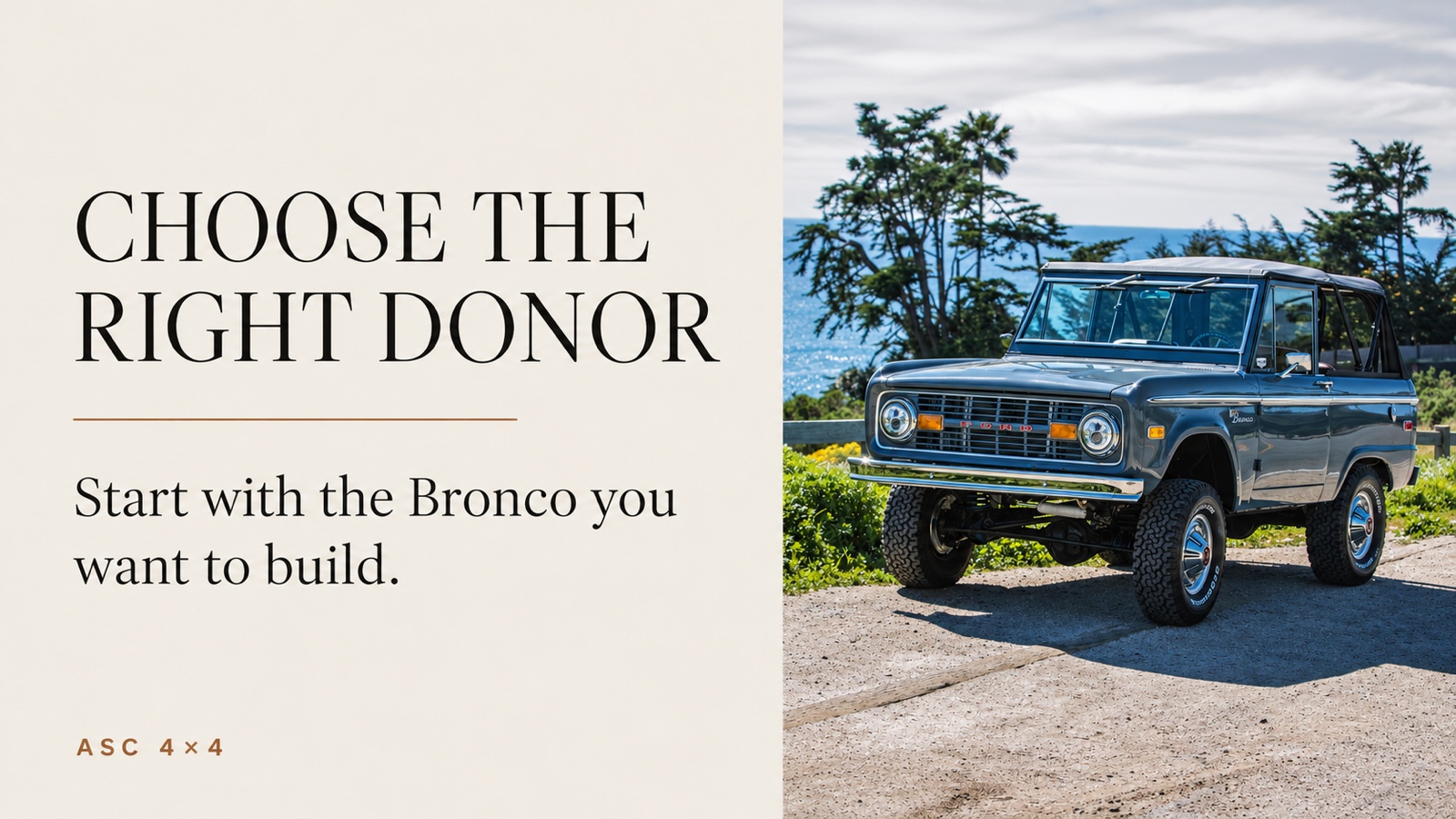
The right Early Bronco donor is the one that supports the Bronco you intend to finish. Purchase price and completeness matter, but they do not answer the central question: does this vehicle give the project the right identity, structure, and design latitude?
That question is easy to lose when a rare 1966–1977 Bronco appears for sale. Decide what the finished vehicle should be first. Then evaluate the candidate against that brief. ASC’s Vintage 4×4 Buyer’s Guide covers the broader choice between buying, restoring, and commissioning. This guide focuses on choosing a foundation for a custom build.
Start with the build, not the donor
Write down the intended result in plain terms: factory-minded restoration, modernized restomod, period-inspired custom, or ground-up vehicle. Include the intended use, body style, wheel-and-tire direction, powertrain, cabin, and the original details you want to keep.
Then sort those priorities into three groups: must remain, can change, and still undecided. This keeps a donor’s attractive paint or rare trim from quietly steering the whole project before you have considered the finished truck.
Match the foundation to the kind of build
For a factory-minded restoration
Originality and vehicle identity carry more weight. A candidate with the right model-year character, a documented title history, and more of its original configuration gives the project more to preserve. Decide whether the goal is a particular model year or trim, and how much deviation the finished Bronco can tolerate.
A complete-looking vehicle is not automatically the better foundation. The important question is whether its identity and surviving components support the restoration standard you want. Have the body, frame, and documentation assessed before treating a purchase as a restoration-ready truck.
For a restomod
A restomod retains the classic Bronco’s shape and character while making deliberate changes to how it drives and feels. Choose a foundation whose body configuration, frame, and documented identity fit the planned work. Decide early whether the truck will stay uncut, use modified fenders, retain a hardtop, or receive a different interior and drivetrain.
The more integrated the mechanical plan, the more important it is to establish the project’s architecture before buying components. Engine, transmission, transfer case, axles, brakes, steering, suspension, cooling, and electrical systems must be specified as one vehicle.
For a ground-up or replica-style project
The donor is only one part of the foundation. Chassis, body, VIN, title, and the state’s vehicle classification can affect how the finished vehicle is identified and registered. Do not assume a Bronco-shaped body or a familiar model year establishes the finished vehicle’s legal identity.
If a replacement frame, reproduction body, kit, or newly assembled vehicle is part of the plan, resolve the registration path before fabrication. California’s DMV guidance on specially constructed or modified vehicles is a useful starting point, but the exact vehicle configuration needs to be reviewed with the relevant agency.
Five questions for every candidate
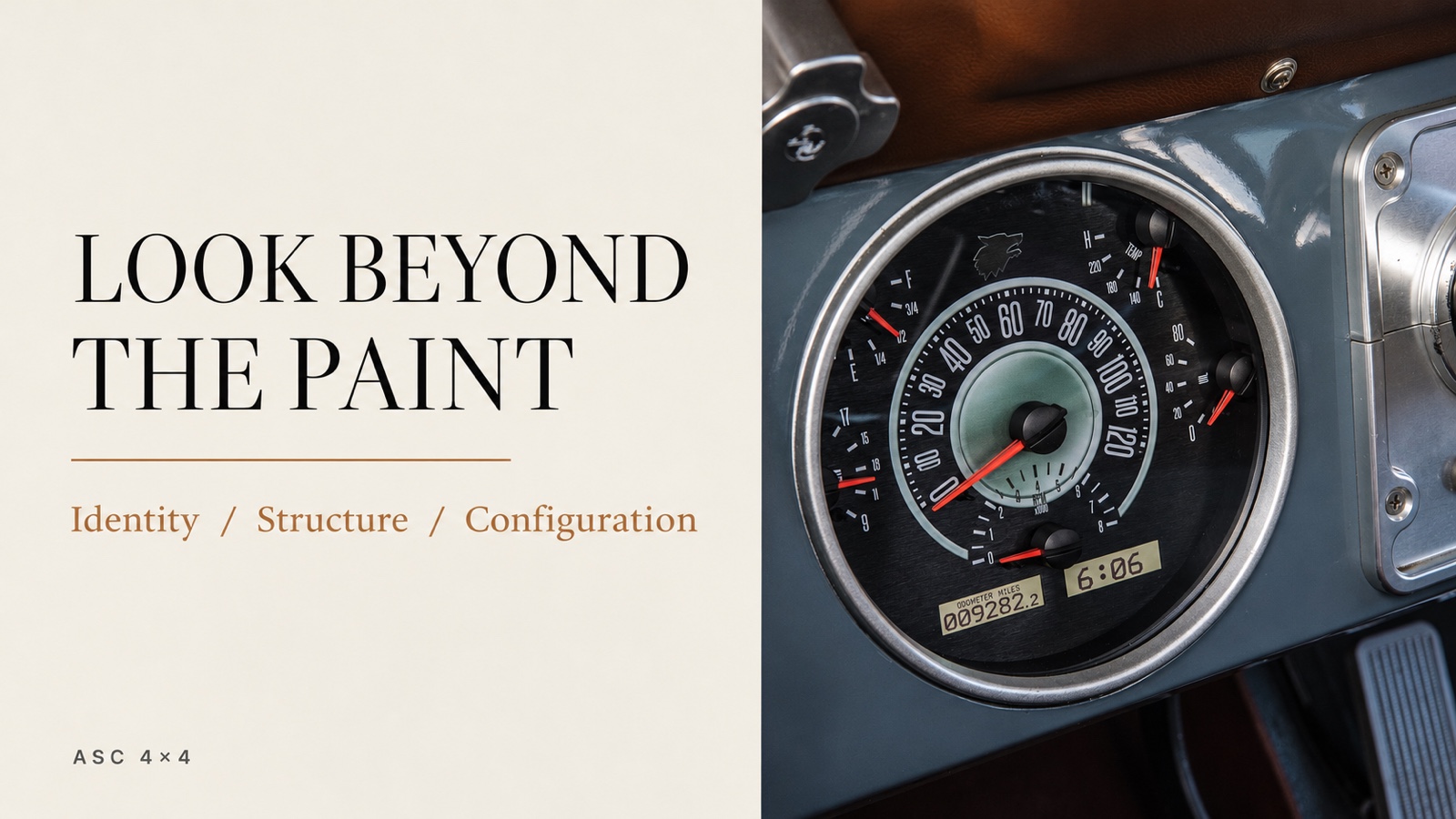
- Does the vehicle’s identity support the project? Check the VIN, title, registration history, and the relationship between the documents and the vehicle.
- Does the body configuration fit the brief? Decide whether uncut fenders, a particular roof, doors, or model-year details are essential.
- Can the foundation support the planned systems? Have the frame and body evaluated against the intended suspension, drivetrain, and wheel-and-tire package.
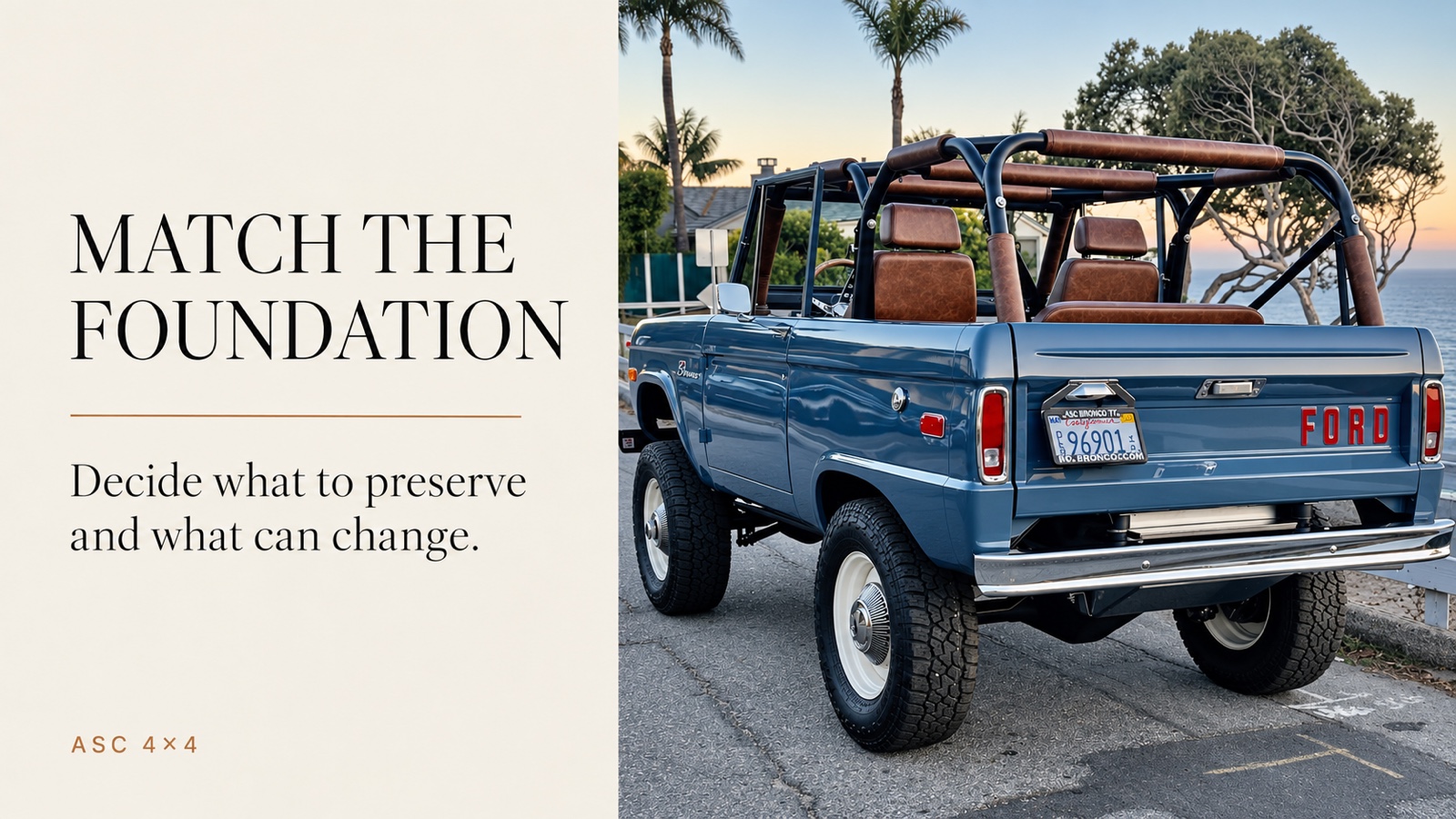
- Which parts are worth preserving? Original components can matter to authenticity, design, or simply the owner’s connection to the vehicle. Record them before work begins.
- What is the build allowed to become? If originality is the point, place limits on modification. If the goal is a one-off, make room for design decisions without losing the Bronco’s proportions.
This is a project-fit review, not a substitute for a physical inspection. ASC’s Early Bronco rust-repair guide and frame and body-mount integrity guide cover condition questions. For builder selection, see ASC’s guide to choosing a restoration shop.
A donor is a design decision
Two Broncos can look similar in a listing and lead to very different builds. One may be the right candidate for a historically faithful restoration. Another may suit a custom drivetrain and interior. A third may carry documentation or identity questions that need to be resolved before it becomes a viable project.
The strongest purchase decision is made with the end state in view. Gather clear photos, the VIN and title details, current registration, known modifications, and your intended specification. A builder can then assess whether the vehicle is the right starting point, what should be preserved, and where the scope needs to be defined.
Should I buy the most complete Early Bronco I can find?
Not automatically. Completeness is one factor. The vehicle’s identity, structure, model-year details, and fit with the finished-build brief matter just as much. A specialist should assess the candidate before you commit to a major project.
Is a donor required for a custom Early Bronco build?
No single donor strategy suits every project. A restoration usually starts with an existing vehicle whose identity and original features matter to the owner. A custom or replica-style project may involve a different chassis or body plan, but the legal and registration implications should be settled before fabrication.
What should I send a builder before buying a Bronco?
Send the model year, VIN and title status through a private channel, current registration, photographs of the frame and body, known modifications, and a short description of the finished truck you want. Avoid sharing a full VIN publicly.
ASC 4×4 builds classic Broncos around the vehicle and the owner’s brief. If you are considering a donor, call (310) 396-6341 before purchase or use ASC’s restoration inquiry page.