
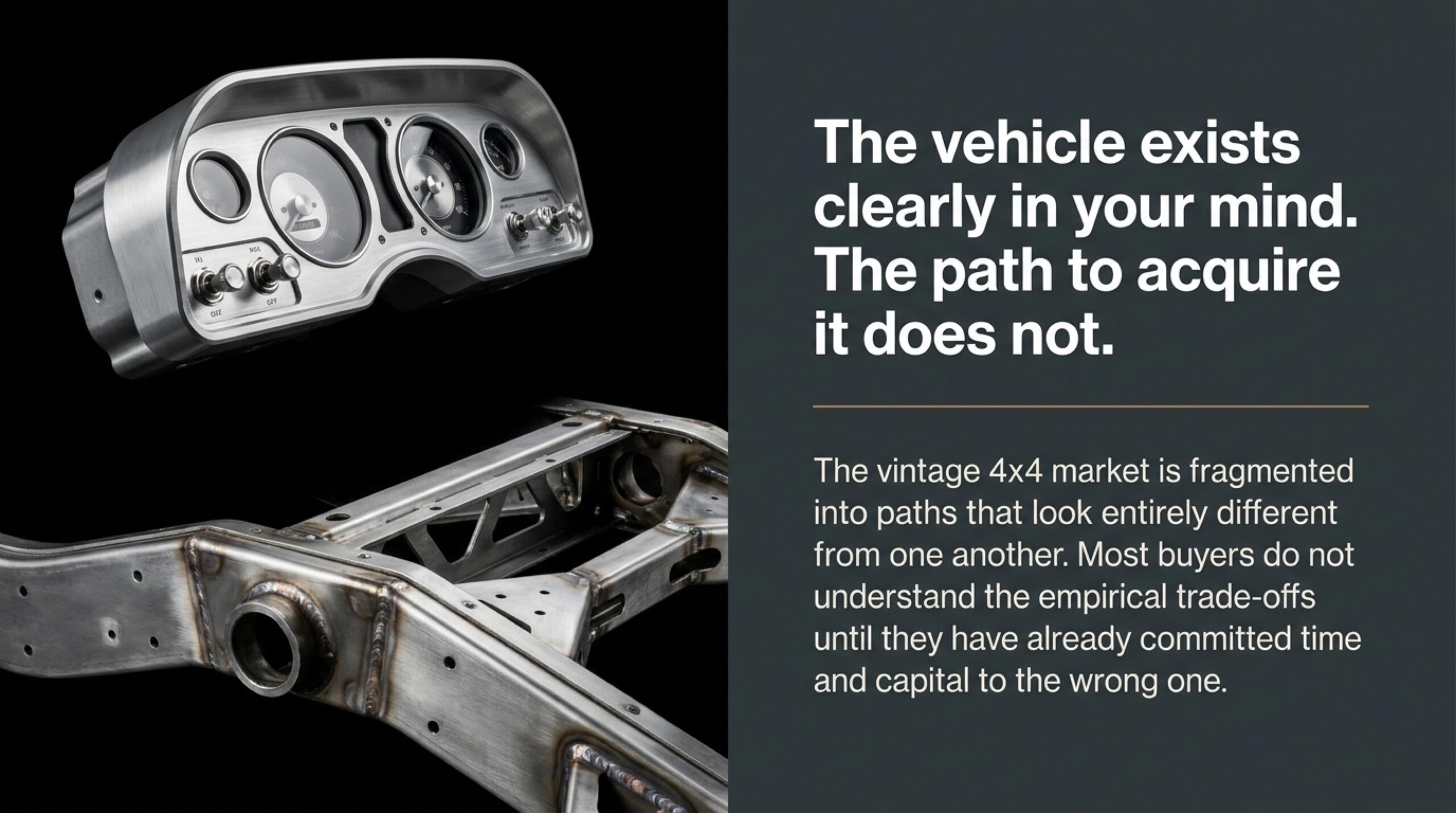
You want a vintage 4×4. Maybe it’s an Early Bronco. Maybe it’s a Scout, a classic Defender, or a Land Cruiser. The vehicle is clear in your head — the color, the stance, the way it sounds at idle. What’s less clear is how to actually get it. That’s what our vintage 4×4 buyer’s guide will teach you!
Deciding on an acquisition path is where most people get stuck. Not because trucks don’t exist on the market, but because the paths to ownership look very different from each other — and most buyers don’t understand the real trade-offs until they’ve already committed time and money to the wrong one.
This vintage 4×4 buyer’s guide breaks down every acquisition path available to you: buying ready-to-drive from an auction, dealer, or private seller; buying a rough project and tackling it yourself; handing a truck to a professional shop; or building exactly what you want on a vetted body. Each path has a different cost structure, a different risk profile, and a different outcome. The goal here isn’t to tell you what to do. It’s to make sure you understand what you’re choosing before you choose it.
The Five Paths to Vintage 4×4 Ownership
Before we break down each option in this vintage 4×4 buyer’s guide, here’s the landscape:
| Path | Entry Cost | Total Cost | Timeline | Risk Level | Control Over Outcome |
|---|---|---|---|---|---|
| Buy ready to drive (auction/dealer/private) | $25,000–$150,000+ | Purchase price + deferred maintenance | Immediate | Moderate | Low — you get what exists |
| DIY project | $3,000–$25,000 | $30,000–$80,000+ all-in | 1–5+ years | High | High — if you have skills |
| Shop restoration (your truck) | $15,000–$40,000 (truck) + shop fees | $80,000–$200,000+ | 12–36 months | Moderate | Moderate — depends on shop |
| Donor body build (shop-sourced) | Included in build cost | $80,000–$200,000+ | 6–18 months | Low | High — built to your spec |
Every path can get you a truck. Not every path gets you the truck you actually want at the price you expected on the timeline you need.
Path 1 — Buy Ready to Drive
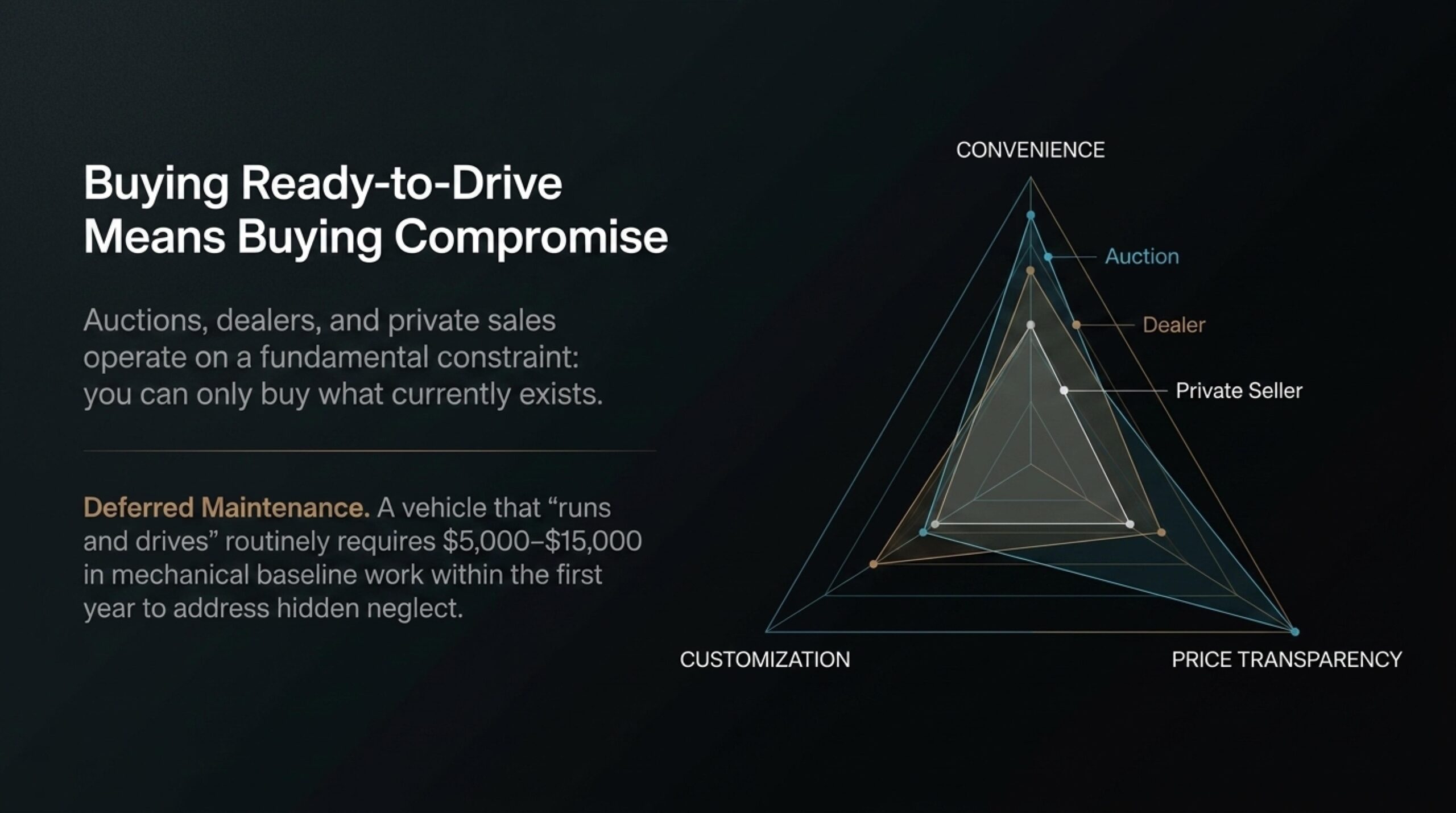
This is the most intuitive path: find a vintage 4×4 that’s already restored or in solid running condition, pay for it, drive it home. Three channels exist for this.
Auctions (Online and Live)
Platforms like Bring a Trailer have transformed the vintage vehicle market. Online auctions offer broad selection, transparent bidding history, and community commentary that helps surface both quality builds and red flags. Live auctions — Mecum, Barrett-Jackson, and regional events — offer the experience of seeing trucks in person before bidding.
What works: You can see a wide range of vehicles quickly. Bidding histories on platforms like BaT give you real market data. Community comments often catch issues the seller didn’t disclose. For trucks with documented build histories from reputable shops, auctions are an efficient marketplace.
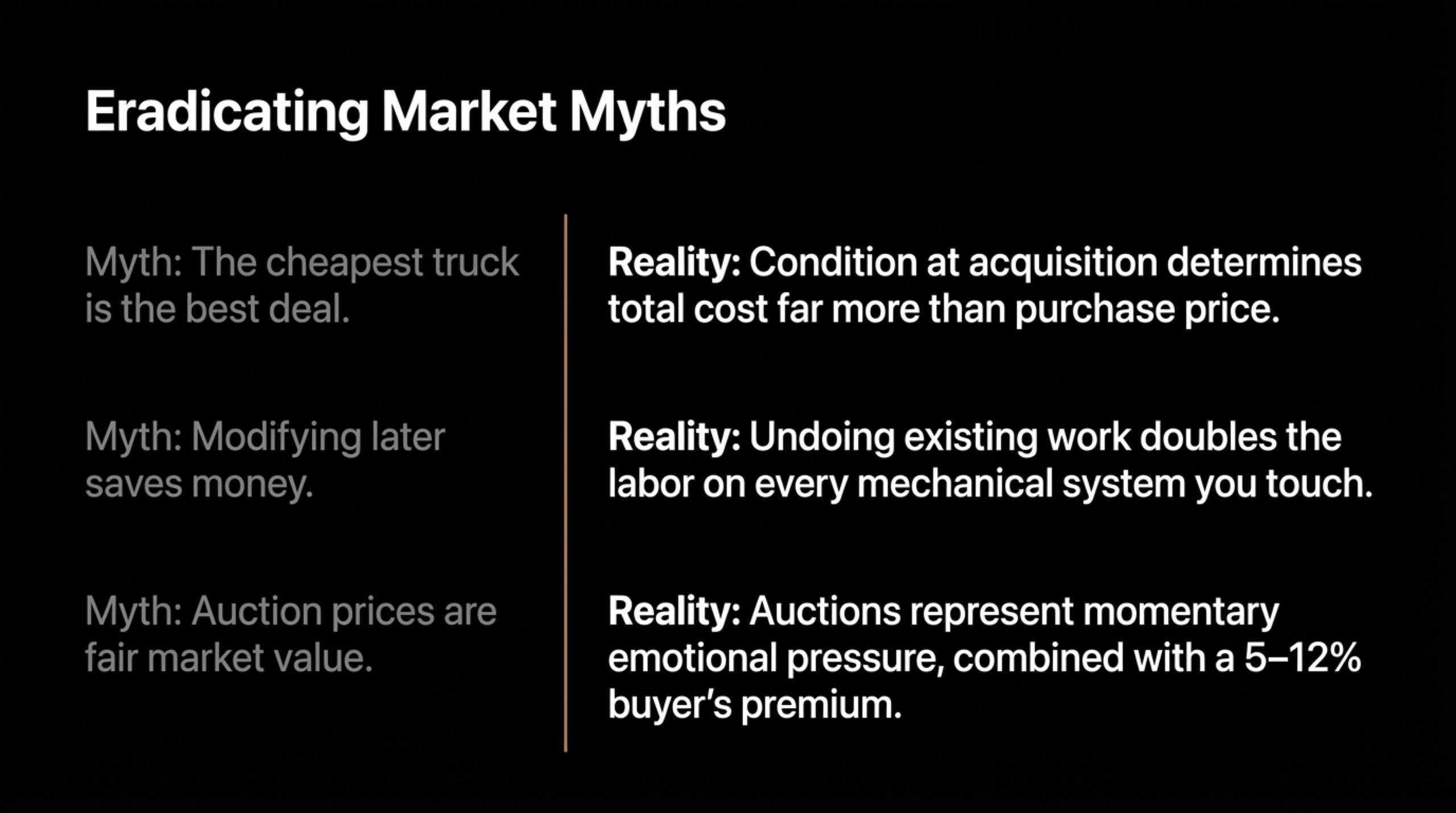
What doesn’t: Auction vehicles are sold as-is. Buyer’s premiums add 5–12% to the hammer price. Online listings can obscure condition issues — professional photography makes everything look better than it is. The competitive bidding environment creates emotional pressure that leads to overpaying. And the biggest issue: you’re limited to what’s listed. If you have a specific vision — a particular color, drivetrain, interior spec — you may wait months or years without finding it.
The hidden cost: Deferred maintenance. A truck that “runs and drives” may need $5,000–$15,000 in work within the first year to address issues the previous owner deferred, the restoration shop cut corners on, or that simply weren’t visible in listing photos. Budget accordingly.
Dealers and Classic Car Lots
Classic vehicle dealers curate inventory, handle paperwork, and provide some level of accountability that private sales and auctions lack. Specialty dealers who focus on specific marques — Broncos, Land Cruisers, Scouts — typically have deeper knowledge and more relevant inventory than general classic car lots.
What works: Dealers handle title, registration, and financing logistics. Reputable dealers stake their reputation on the vehicles they sell. Some offer limited warranties or return policies. You can inspect in person, test drive, and ask detailed questions with a reasonable expectation of honest answers. For buyers who value convenience and risk reduction, dealers offer a streamlined path.
What doesn’t: You’re paying for that convenience. Dealer margins on classic vehicles typically range from 15–30% above what the same truck would sell for privately. Inventory is limited to what the dealer has acquired. And dealer quality varies enormously — some are meticulous about what they sell, others are flippers who clean up questionable trucks and move them quickly. Due diligence on the dealer matters as much as due diligence on the truck.
The hidden cost: Dealer markup funds their operation, not the truck’s quality. A $75,000 Bronco at a dealer may be a $55,000 truck with $20,000 of margin — or it may be a $70,000 truck with $5,000 of margin. The only way to know is to understand the truck’s actual condition independently.
Private Sellers
Buying directly from an owner eliminates the middleman and often provides the most detailed vehicle history available. Long-term owners can tell you things no listing or dealer ever will — what was repaired, what’s been temperamental, what they’d do differently.
What works: Best potential pricing. Direct access to the owner’s knowledge and records. Ability to negotiate freely. Often the only way to find trucks that never make it to auction or dealer lots — the owner mentions it at a cars-and-coffee event, posts in a forum, or tells a friend.
What doesn’t: No accountability after the sale. Condition representation is entirely on the seller’s honesty. No warranty. Title and paperwork issues are more common. And for out-of-state purchases, logistics and inspection become your problem entirely. The emotional dynamics of private sales also create risk — a seller who loves their truck may genuinely believe it’s in better condition than it is. They’re not lying; they’re just not objective.
The hidden cost: Inspection and transport. A professional pre-purchase inspection costs $300–$600. Enclosed transport across the country runs $1,500–$3,000. If you fly to see a truck and it’s not what was represented, you’ve lost travel costs with nothing to show for it. Budget two or three inspection trips into your private-sale plan.
The Fundamental Limitation of Buying Ready-to-Drive
Across all three channels, the same constraint applies: you can only buy what exists. If you want a specific color on a specific year with a specific drivetrain, specific interior, and specific stance — the odds of finding that exact truck, in the condition you want, at a price that makes sense, are low. The more specific your vision, the longer the search. Many buyers spend a year or more looking, make compromises they’re not happy with, or settle for “close enough” and then spend another $20,000–$40,000 modifying what they bought to match what they actually wanted.
This is the gap that custom builds were designed to fill.
Path 2 — Buy a Project and Do It Yourself
The romance of the project truck is powerful. You find a rough but promising 4×4 for a fraction of the cost of a finished one, and over weekends and evenings, you bring it back to life with your own hands. The truck becomes yours in a way that writing a check for a finished vehicle never replicates.
This path is real. People complete DIY restorations every day. But the gap between the fantasy and the reality is wider than most buyers expect. This section of the vintage 4×4 buyer’s guide breaks down why it’s tempting for many but right for only a few.
The Appeal
A non-running or rough-condition vintage 4×4 can be acquired for $3,000–$25,000 depending on the vehicle, its condition, and its location. That’s a fraction of a finished truck’s value. For someone with fabrication skills, mechanical knowledge, shop space, and time, the savings are genuine. The satisfaction of completing a build with your own hands is irreplaceable. And you control every decision — every component, every detail, every compromise.
The Math
Here’s where the appeal runs into arithmetic.
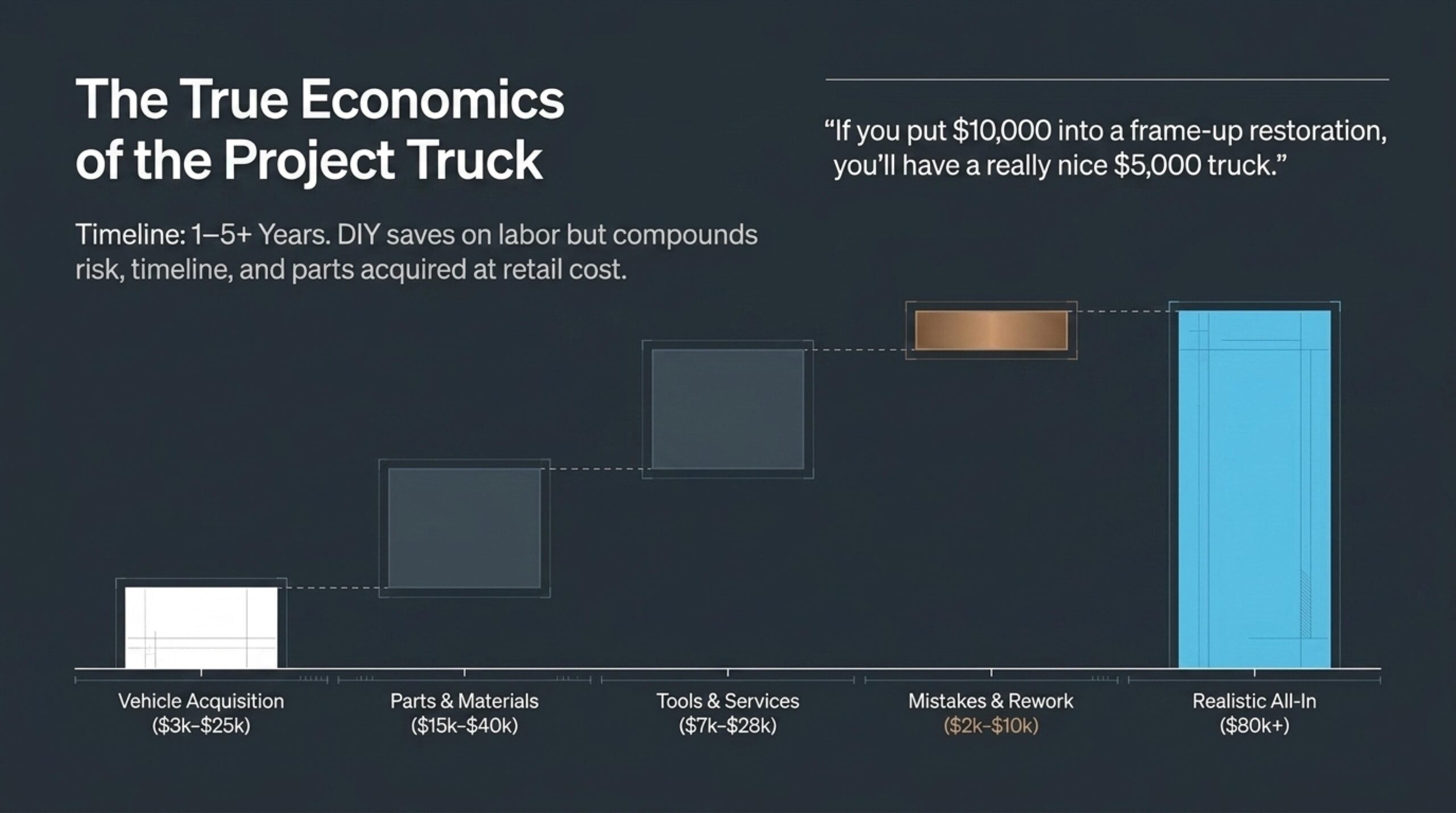
Vehicle acquisition: $3,000–$25,000
Parts and materials: $15,000–$40,000 (and this number almost always goes up)
Tools you don’t own yet: $2,000–$8,000
Professional services you can’t do yourself (machining, plating, paint, upholstery): $5,000–$20,000
Consumables (welding wire, abrasives, fluids, fasteners, primer): $2,000–$5,000
Mistakes and rework (everyone has them): $2,000–$10,000
Realistic all-in for a quality DIY build: $50,000–$100,000+
That range assumes you’re doing most of the labor yourself. If you’re paying someone for the hard parts — bodywork, paint, mechanical — the number approaches or exceeds what a professional restoration would cost, without the benefit of professional accountability.
Then there’s time. A realistic DIY restoration takes 1–3 years of consistent work. Many take longer. Forum threads are filled with projects that stalled at year two because the owner ran out of money, ran out of enthusiasm, or realized the rust was worse than they thought. A common saying in classic truck forums captures this accurately: “If you put $10,000 into a frame-up restoration, you’ll have a really nice $5,000 truck.” The economics of DIY rarely pencil out when you factor in the real cost of your time.
The Reality
DIY restoration makes sense for a specific person: someone with existing fabrication and mechanical skills, a properly equipped shop, realistic expectations about timeline and budget, and genuine enjoyment of the process itself — not just the outcome.
If you’re buying a project because it’s the cheapest entry point, you’re making a financial decision that will almost certainly cost more than you planned. If you’re buying it because you love the work, and you understand the real math, it can be one of the most rewarding things you’ll ever do.
Our honest recommendation: If you’ve never restored a vehicle before, a non-running vintage 4×4 is not the place to start. The learning curve is steep, the parts are expensive, and the margin for error on structural and safety work is zero. If you want to learn, start with a running truck that needs cosmetic and mechanical attention — not a shell that needs everything.
Path 3 — Buy a Truck and Have a Shop Restore It
This is the path most buyers assume is the “right” answer: find a vintage 4×4 with good bones, take it to a reputable shop, and have them handle the restoration. You get professional quality without the DIY time commitment.
The approach works. Here, the vintage 4×4 buyer’s guide exposes the variables that aren’t obvious until you’re deep into the process.
What You’re Paying For
Professional restoration labor rates for quality shops typically run $75–$150 per hour. Labor represents 50–70% of total restoration cost. A comprehensive frame-off restoration from a reputable shop ranges from $60,000 to $150,000+ in labor and materials — on top of whatever you paid for the truck itself.
What that buys you: expertise, efficiency, accountability, and a finished product that reflects professional standards. A shop that’s built dozens or hundreds of vintage 4×4s works faster, makes fewer mistakes, and solves fabrication challenges that would stop a DIY builder cold.
The Process
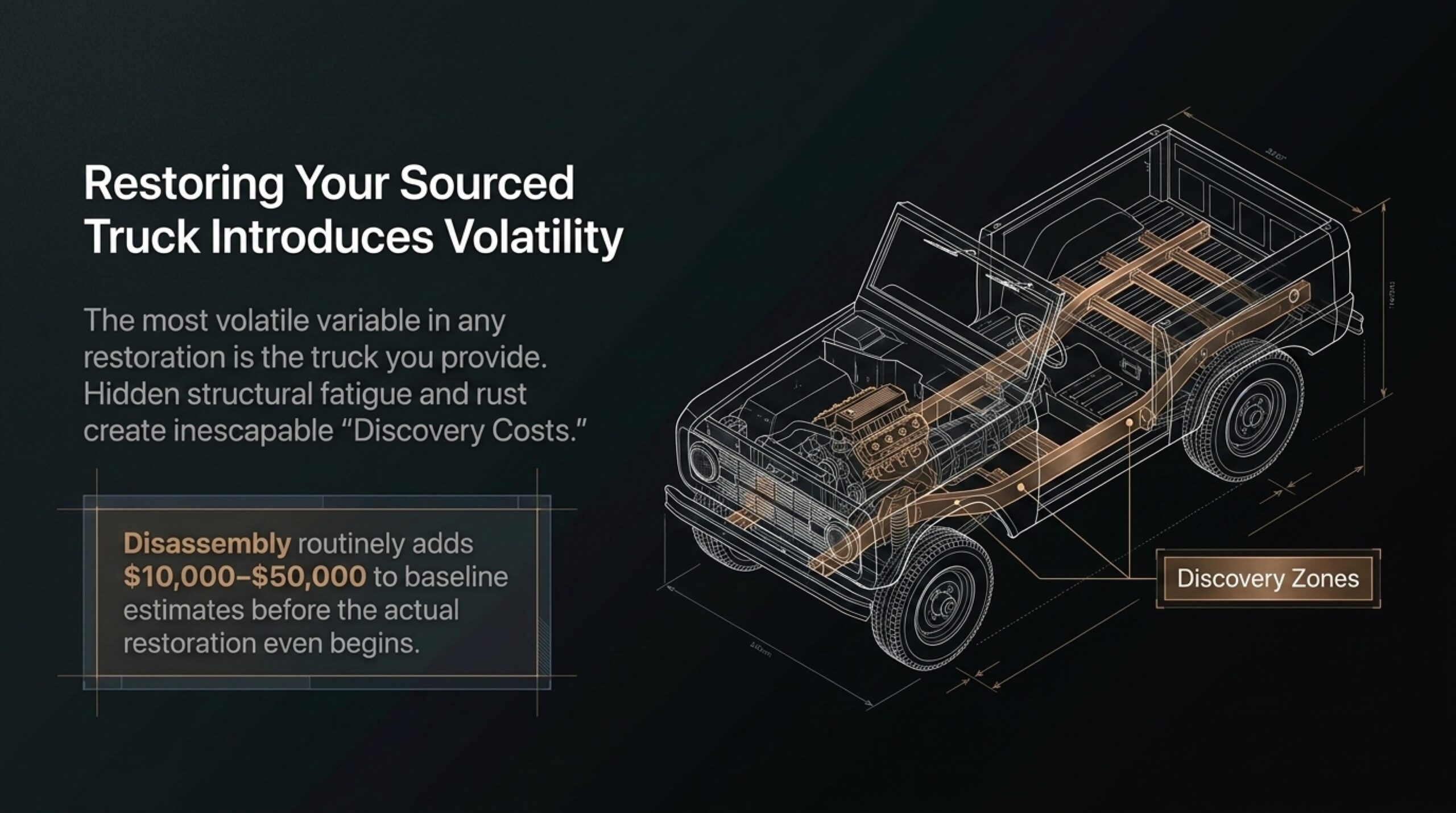
You source a truck. The shop evaluates it, provides an estimate, and establishes a timeline. Then disassembly begins — and this is where estimates change.
Every restoration shop will tell you the same thing: the real condition of a truck isn’t known until it’s torn apart. That “solid” body may reveal hidden rust when the paint comes off. That “rebuilt” engine may have issues that weren’t visible with the covers on. The frame that looked straight may have damage hidden by undercoating.
Reputable shops communicate changes transparently and adjust estimates as discoveries are made. But the reality is that restoration estimates are educated guesses until disassembly reveals the truth. A $70,000 estimate can become $100,000+ when hidden problems surface.
The Risk
In this path, the risk isn’t the shop’s work — assuming you’ve chosen a reputable one. The risk is in the truck you bring them.
The truck you source is the biggest variable in your build. If you buy a rough truck because the price was right, you may spend $30,000–$50,000 in metalwork and structural repair before the actual restoration even begins. If you buy a solid truck with good bones, those dollars go toward the build you actually want instead of fixing problems that existed before you started.
This is why sourcing matters as much as building. The cheapest project truck is often the most expensive restoration.
Path 4 — Build on a Vetted Donor or Reproduction Body
This is the path most buyers don’t know exists — and it addresses the limitations of every other option.
Why Donor Bodies Exist
The vintage 4×4 market has a supply problem. The trucks that remain fall into a spectrum: pristine examples that command six figures, solid drivers in the $40,000–$80,000 range, and rough projects that need everything. The middle of that spectrum — good bones, reasonable price, acceptable condition — gets thinner every year. Rust doesn’t stop. Neglect compounds. The supply of “good starting points” is shrinking.
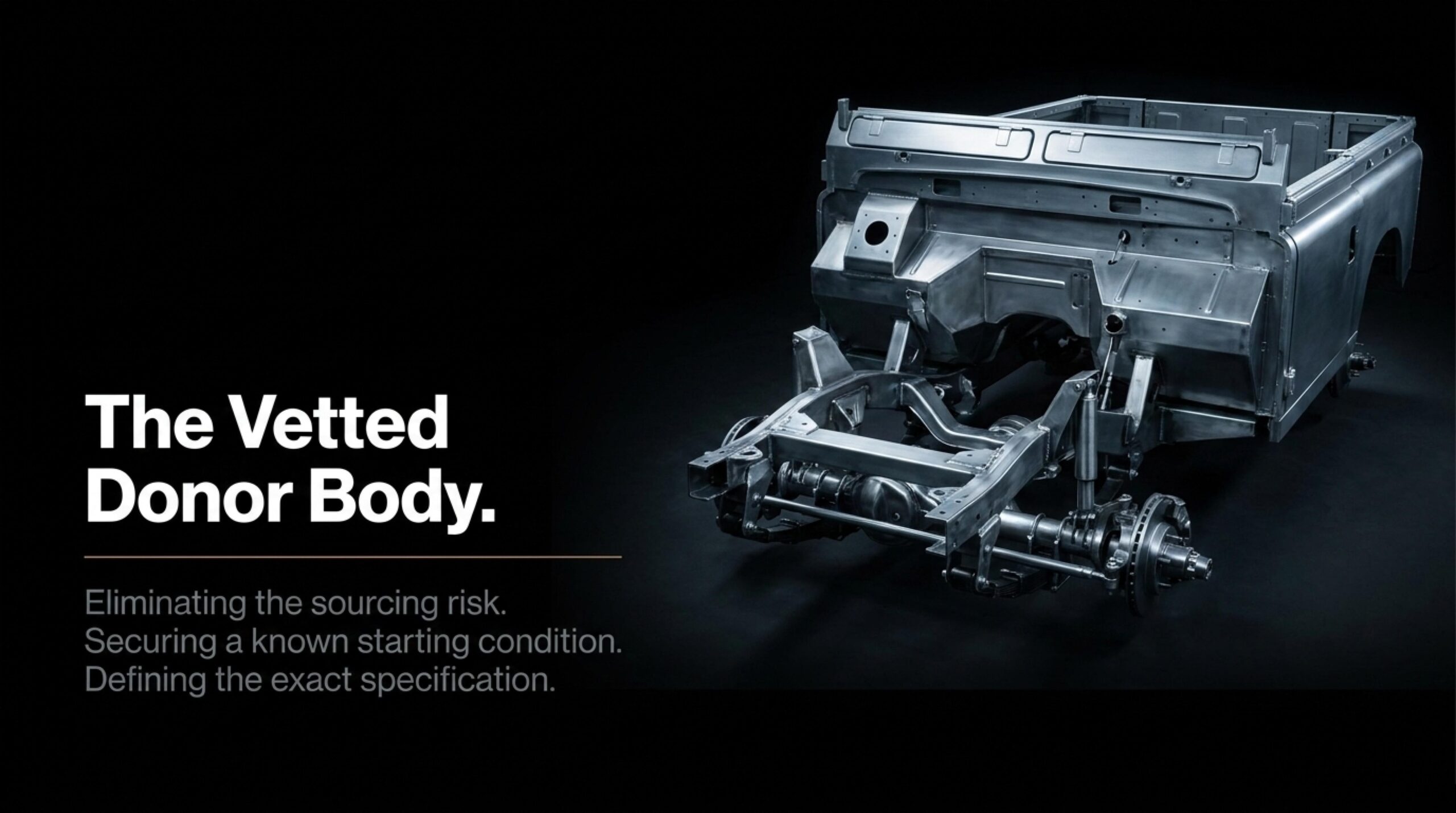
Donor and reproduction body programs solve this by separating the search from the build. Instead of hunting for the right truck and hoping its condition matches your expectations, a shop sources, evaluates, and inventories body shells and frames that meet specific structural and condition standards. When you’re ready to build, the starting point is already vetted — no surprises, no hidden rust, no discovery phase that doubles your budget.
What a Vetted Donor Means
A vetted donor body isn’t just any shell pulled from a field. It’s been inspected for structural integrity, metal condition, and suitability for restoration. Problem areas have been identified and documented. The body is ready to enter the build process with known quantities — not unknown liabilities. Reproduction bodies are brand-new sheet metal, stamped and welded, and shipped partially assembled with all the components to build your exact dream rig.
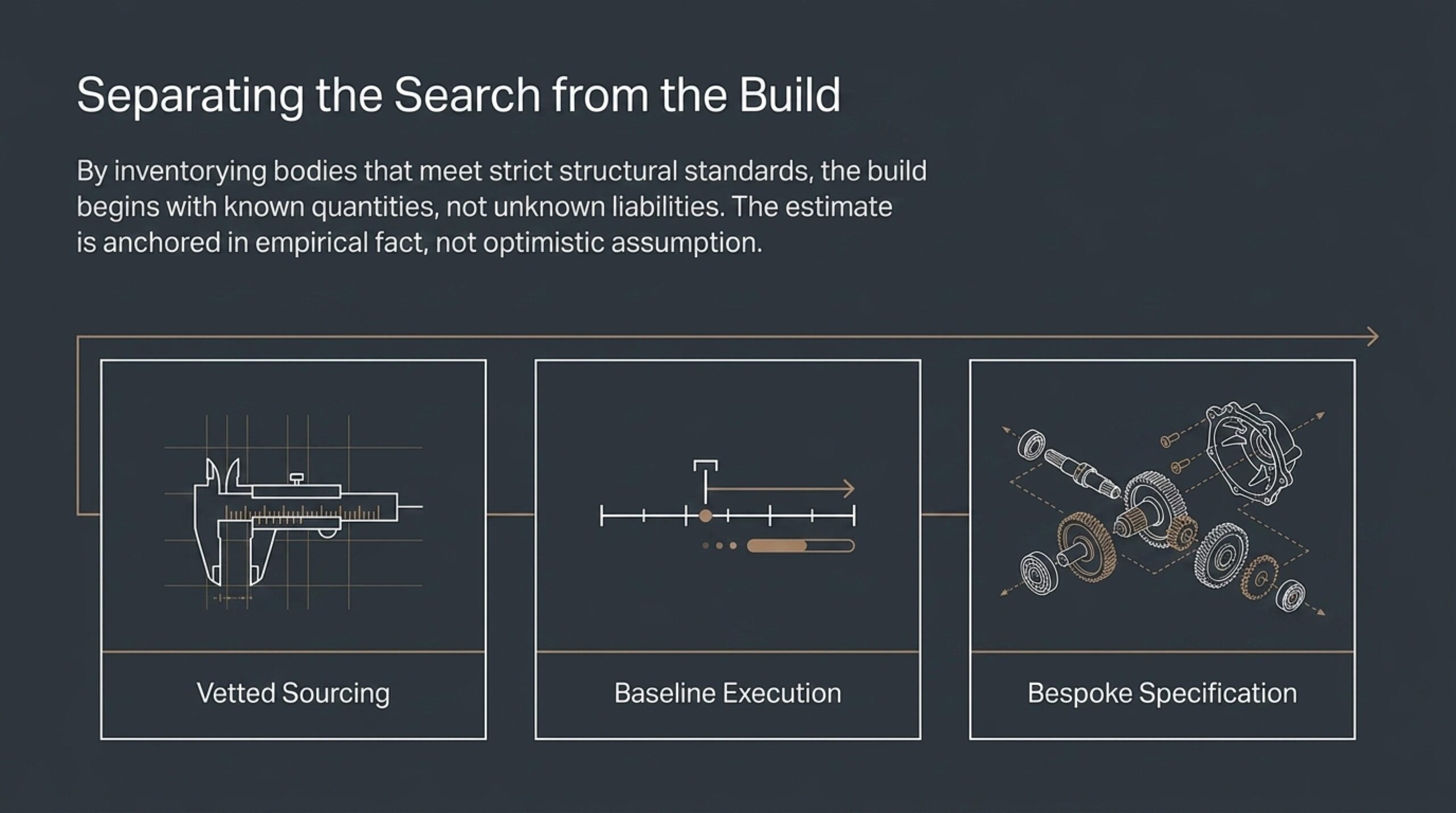
This eliminates the single biggest cost variable in vintage 4×4 restoration: the condition of the starting vehicle. When the body is vetted before you commit, the estimate your shop provides is based on known facts rather than optimistic assumptions.
How the Build Works
You choose your spec: color, drivetrain, interior, suspension, stance, use case. The donor body enters the build process already assessed and prepared. The shop executes your build to the specifications you’ve defined, with a timeline and budget based on real conditions rather than best-case scenarios.
The result is a truck built to your exact vision — not a compromise based on what you could find, not a gamble on what’s hiding under the paint, and not a modified version of someone else’s taste. It’s yours from the ground up, on a foundation that’s been confirmed before a single dollar of build labor is spent.
Why This Path Exists
The most common reason people don’t buy a vintage 4×4 isn’t money. It’s that they can’t find the one they want. They browse auctions for months, fly to look at trucks that don’t match the listing, and settle for the wrong color or the wrong drivetrain or the wrong condition because they’re tired of looking.
Building on a vetted donor body eliminates the search. You’re not limited to what the market has listed today. You define what you want, and the build delivers it — on a foundation that’s been confirmed, not hoped for.
The Real Cost Comparison
Let’s put honest numbers next to each path. These ranges reflect quality outcomes — not the cheapest possible version of each path, but what it actually costs to end up with a truck you’re proud of and that functions correctly.
| Path | Acquisition | Build/Repair | Hidden Costs | Realistic Total | Timeline |
|---|---|---|---|---|---|
| Auction (driver quality) | $30,000–$80,000 | $0 | $5,000–$15,000 deferred maintenance | $35,000–$95,000 | Immediate + repair time |
| Auction (show/restomod) | $80,000–$200,000+ | $0 | $0–$10,000 | $80,000–$210,000+ | Immediate |
| Dealer | $40,000–$250,000+ | $0 | $0–$10,000 + markup built in | $40,000–$260,000+ | Immediate |
| Private sale | $25,000–$200,000+ | $0 | $5,000–$20,000 inspection/transport/repair | $30,000–$220,000+ | 1–6 months searching |
| DIY project | $3,000–$25,000 | $25,000–$60,000+ in parts/services | $5,000–$15,000 in tools/mistakes/rework | $30,000–$80,000+ | 1–5+ years |
| Shop restoration (your truck) | $15,000–$40,000 | $60,000–$150,000+ | $10,000–$50,000 discovery costs | $85,000–$200,000+ | 12–36 months |
| Vetted donor body build | Included | $80,000–$200,000+ | Minimal — body is pre-assessed | $80,000–$200,000+ | 6–18 months |
The numbers tell a story: cheap entry doesn’t mean cheap outcome. A $5,000 project truck that costs $75,000 to restore properly ends up at the same total as a $80,000 donor body build — except the project took three years longer and carried significantly more risk.
The Decision Framework
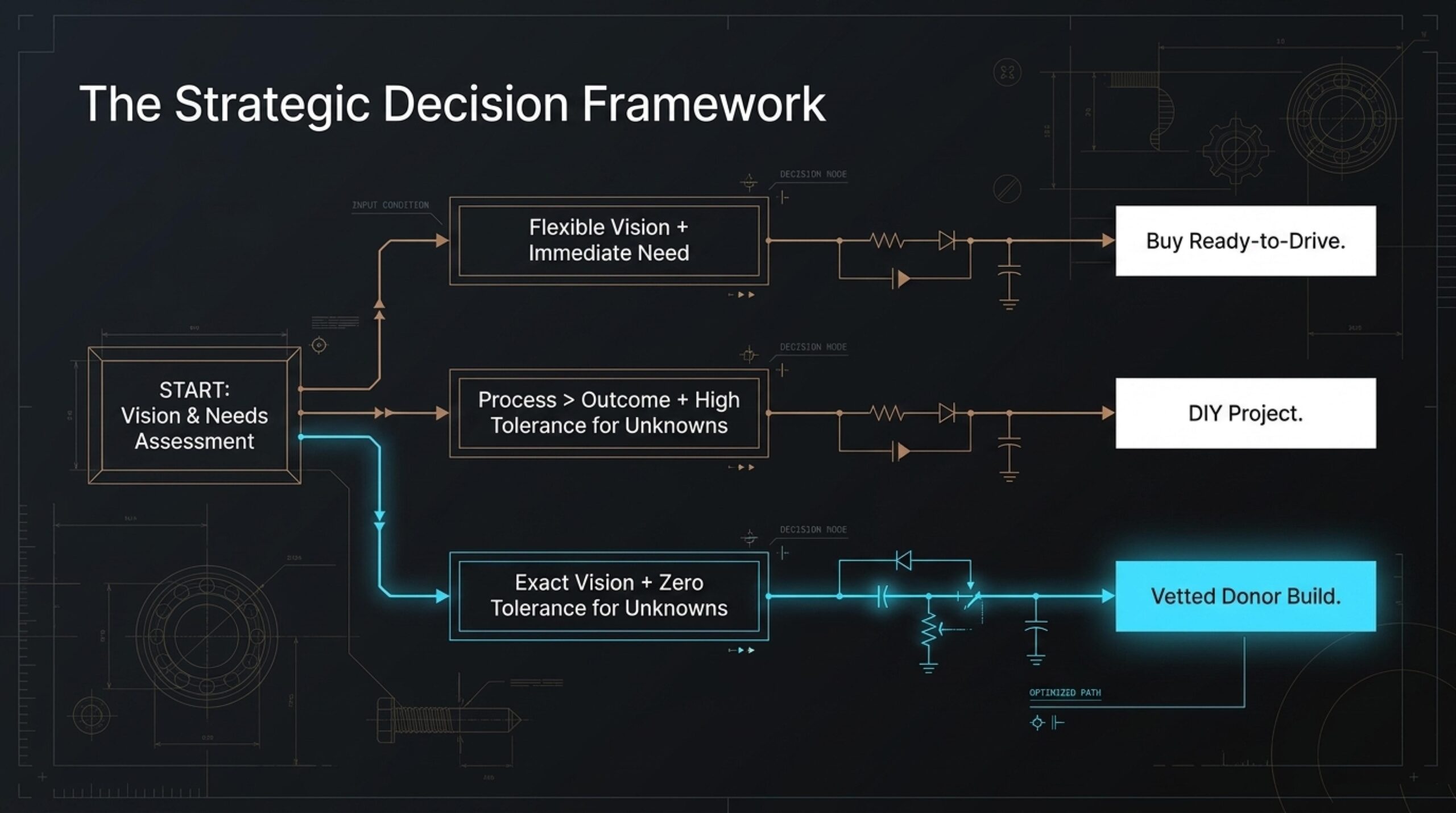
Rather than starting with price, start with these questions:
1. How specific is your vision? If you’ll be happy with a solid driver in whatever color and spec you find, buying ready-to-drive makes sense. If you want something specific — a particular color, a particular drivetrain, a particular interior — the odds of finding that exact combination ready to buy are low. Custom builds exist because specific visions require specific execution.
2. What’s your real timeline? If you need a truck this month, you’re buying what’s available. Wait 6–18 months, and a professional build delivers exactly what you want. For someone who’s comfortable with 2–5 years, DIY is on the table — but be honest about whether that timeline will hold.
3. What’s your tolerance for the unknown? Every acquisition path except the vetted donor build carries significant unknowns. Auctions are as-is. Private sales depend on seller honesty. Projects reveal surprises during disassembly. Even bringing your own truck to a shop involves discovery costs. If surprises stress you, choose the path with the fewest of them.
4. Do you want the process or the outcome? This is the most honest question. If you love wrenching, fabricating, and problem-solving — and you’d do it even if it made no financial sense — a DIY project is for you. If you want the truck, not the process, paying for professional execution is not a shortcut. It’s the direct route.
5. What does your budget actually cover? A $50,000 budget buys a solid driver from a private seller. It does not buy a professional restoration. It might buy a DIY project if everything goes right — but everything rarely goes right. Match your budget to realistic outcomes for each path, not optimistic ones.
Common Mistakes That Cost People Money
Buying the cheapest truck available.
The purchase price of a vintage 4×4 is often the smallest cost in the ownership equation. A $5,000 truck that needs $60,000 of work costs more than a $40,000 truck that needs $5,000 of work. Condition at purchase determines total cost more than any other factor.
Underestimating DIY restoration costs by 50% or more.
Every experienced builder will tell you their project cost roughly double what they initially estimated. Parts prices increase. Hidden damage surfaces. Scope creeps. Tools add up. If your budget is tight, DIY is the highest-risk path, not the safest.
Flying to see trucks without a pre-purchase inspection.
A $500 inspection from a local professional before you book a $1,200 flight saves you from wasted trips. If the seller won’t allow an independent inspection, that tells you everything you need to know.
Settling for “close enough” and planning to modify later.
Buying a red truck when you wanted blue, a 302 when you wanted a Coyote, or a stock suspension when you wanted a lift — and planning to change it all later — almost always costs more than building what you want from the start. Every modification to a finished truck involves undoing someone else’s work before doing yours.
Assuming all restoration shops are equal.
The range in quality, communication, and accountability across restoration shops is enormous. A shop that produces stunning work but can’t hold a timeline or budget causes different problems than one that’s fast but cuts corners. Evaluate shops on finished work, client references, and communication — not just their Instagram feed.
Not accounting for the search itself.
Time spent searching is a real cost. Months of browsing listings, driving to see trucks that don’t match their descriptions, and losing auctions to higher bidders adds up in both time and frustration. For buyers with specific visions, the search cost often exceeds the perceived savings of finding a deal.
FAQs
Should I buy a restored vintage 4×4 or restore one myself?
That depends on whether you want the process or the outcome. If you have fabrication skills, shop space, and genuinely enjoy the work, DIY restoration is deeply rewarding — but expect to spend $30,000–$80,000+ and 1–3 years. If you want the truck, not the project, buying restored or commissioning a professional build delivers the outcome faster and with more predictable results. The total cost often ends up similar; the difference is how your time and risk are allocated.
Are vintage 4×4 auctions a good place to buy?
Online auctions like Bring a Trailer are an excellent research tool and marketplace for documented, quality builds. The risks are as-is sales, buyer’s premiums (5–12%), and the emotional pressure of competitive bidding. The biggest advantage is transparency — bidding history, community commentary, and detailed listings help you understand what you’re buying. Budget for deferred maintenance on any auction purchase, even well-documented ones.
How do I avoid buying a money pit?
Focus on condition over price. A truck that costs more up front but has solid structure, documented history, and quality components will cost less over time than a cheap truck hiding expensive problems. Get an independent inspection before committing to any purchase. Be especially cautious with non-running vehicles — the reasons they stopped running are often more expensive than the purchase price.
What’s the advantage of building on a donor body?
Three things: elimination of sourcing risk, known starting condition, and full specification control. You’re not searching for a truck that matches your vision — you’re defining the vision and building it. The donor body has been evaluated before you commit, so the estimate reflects real conditions rather than assumptions. And you choose every detail — color, drivetrain, interior, suspension — rather than compromising based on what’s available.
How long does a professional vintage 4×4 restoration take?
Frame-off professional restorations typically take 12–24 months depending on scope and shop workload. Builds on vetted donor bodies can move faster — 6–18 months — because the discovery phase is eliminated. DIY restorations commonly take 1–5 years, with many extending well beyond initial estimates due to budget constraints, parts sourcing, and competing life priorities.
Can I customize a build if I don’t see what I want for sale?
Yes. This is exactly what spec-built restorations are designed for. You define the year, color, drivetrain, interior, suspension, and intended use. The build is executed to those specifications on a vetted donor body. If you’ve been searching for months without finding the right combination of year, condition, color, and specification — this is likely the most direct path to the truck you actually want.
Is it cheaper to buy a running truck and modify it, or build from scratch?
Usually cheaper to buy running and modify — if the modifications are minor. But if you’re planning to change the drivetrain, suspension, paint, and interior, the math reverses quickly. Undoing existing work before redoing it doubles the labor on every system you touch. If your vision differs significantly from what’s available on the market, building to spec often costs the same or less than buying and extensively modifying.
The vintage 4×4 market rewards patience, knowledge, and honest self-assessment. Every path to ownership has trade-offs. The buyers who end up happiest are the ones who understood those trade-offs before they committed — not the ones who got the lowest purchase price.

Whatever path you choose, go in with clear goals, realistic expectations, and a budget that accounts for reality rather than hope. The truck is worth it. The process should be too.
Ready to talk through your options? Whether you’re evaluating a specific truck, comparing acquisition paths, or ready to spec a custom build on a vetted donor body — we work with serious buyers locally in Southern California and coordinate remotely nationwide. Quality craftsmanship and honest guidance aren’t limited by geography.
asc4x4.com | (310) 396-6341

Additional Reading:
The Best Bronco Restoration Company: How to Actually Choose One
How Much Does It Really Cost to Restore an Early Bronco?
Restomod vs Restoration: Which Path Is Right for Your Early Bronco Build?