
A frame-off restoration separates the body from the chassis so the frame and the vehicle’s underlying systems can be inspected and addressed with full access. The phrase describes a method of disassembly. By itself, it does not tell you what will be repaired, replaced, retained, or how the finished Bronco will be judged.
That distinction matters when you are commissioning a 1966–1977 Ford Bronco. A frame-off build can aim for factory character, a show-level finish, or a carefully integrated restomod. The scope should make that choice clear before the truck comes apart.
For an overview of the process, read ASC’s frame-off restoration guide. The checklist below focuses on the decisions to put in writing.
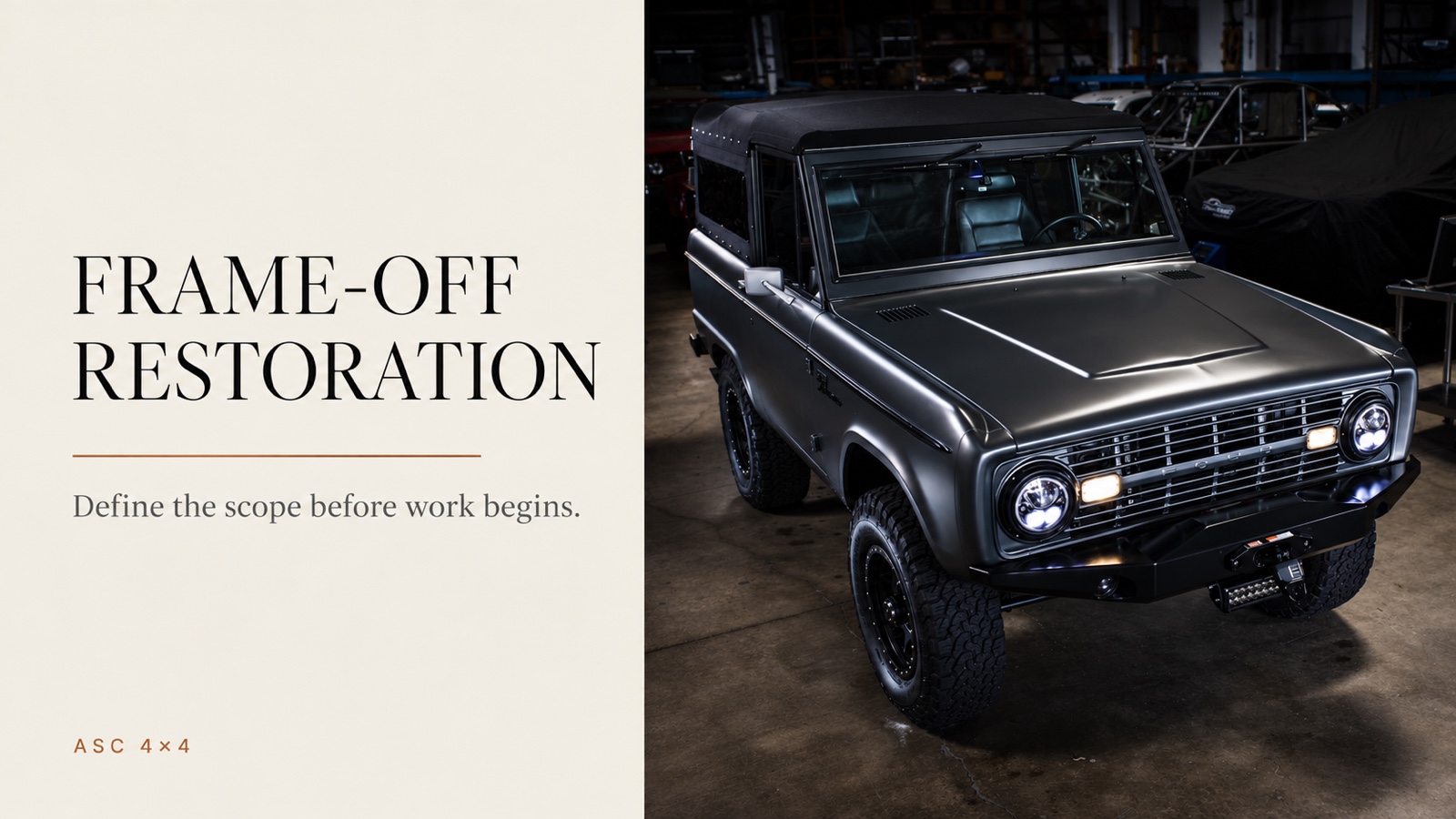
What “frame-off” does and does not mean
Removing the body from the frame creates access. It does not automatically mean every component will be new, every panel will be replaced, or the truck will be restored to a specific standard. Those are separate decisions.
A useful scope names the intended result and the treatment of each major area. It should say what happens to the chassis, body, drivetrain, steering, suspension, brakes, electrical system, interior, glass, trim, and finish. It should also distinguish inspection from authorized work. “Inspect and advise” is not the same instruction as “repair or replace.”
For an original-style restoration, the brief may prioritize the Bronco’s factory proportions, details, and mechanical character. For a restomod, it may preserve the familiar silhouette while specifying updated power, braking, steering, suspension, climate control, or cabin equipment. Either direction can be executed at a high standard. The point is to choose it deliberately.
The decisions a frame-off scope needs to settle
1. Define the finished Bronco
Start with the truck you want to use, not a parts list. Is the goal an historically faithful restoration, a personal interpretation of a period build, or a modernized Bronco that still reads as an Early Bronco? State how the vehicle will be used and which original features matter most.
Record the non-negotiables: body configuration, stance, paint direction, interior character, powertrain, and any equipment that must remain. That gives the builder a standard against which later choices can be measured.
2. Establish the foundation and identity
Document the Bronco’s year, title, VIN, known history, and existing modifications. Photograph the vehicle before disassembly. Identify which original parts are to be retained, which can be rebuilt, and where replacement components are acceptable.
The vehicle’s identity and registration history belong in the project file. They are not details to reconstruct after fabrication. If the plan includes a replacement body, chassis changes, or a replica direction, resolve the classification questions before buying major parts.
3. Specify chassis and body work separately
The frame and body do different jobs and need different standards. The scope should identify the frame’s inspection and finish requirements, along with the condition of mounting points, crossmembers, suspension locations, and related hardware. For the body, define metal repair, panel fit, door gaps, seam treatment, paint preparation, and the expected finish.
A frame-off restoration does not guarantee perfect panel alignment or a show finish. Those results come from the work specified and the standard used to inspect it. ASC’s Early Bronco rust-repair guide and frame and body-mount integrity guide cover related inspection and workmanship questions.
4. Treat mechanical systems as a package
A powertrain choice affects more than the engine bay. The engine, transmission, transfer case, axles, gearing, cooling, fuel delivery, wiring, exhaust, brakes, steering, and suspension need to work together as a defined build.
If the Bronco is staying close to stock, specify the original-style components and the acceptable alternatives. If it is becoming a restomod, name the intended drivetrain and the supporting systems that must be designed around it. Avoid a scope that treats each upgrade as an isolated purchase.
5. Define assembly, finish, and verification
The written scope should state how hardware, seals, trim, glass, interior pieces, and electrical connections will be handled. It should identify finish samples or approved references where color and material matter. Before the project begins, agree on what counts as complete and what documentation will accompany the Bronco at handoff.
A clear scope does not predict every discovery inside a decades-old vehicle. It does define how discoveries are reviewed, priced, approved, and documented. That is how the finished build remains tied to the original brief.
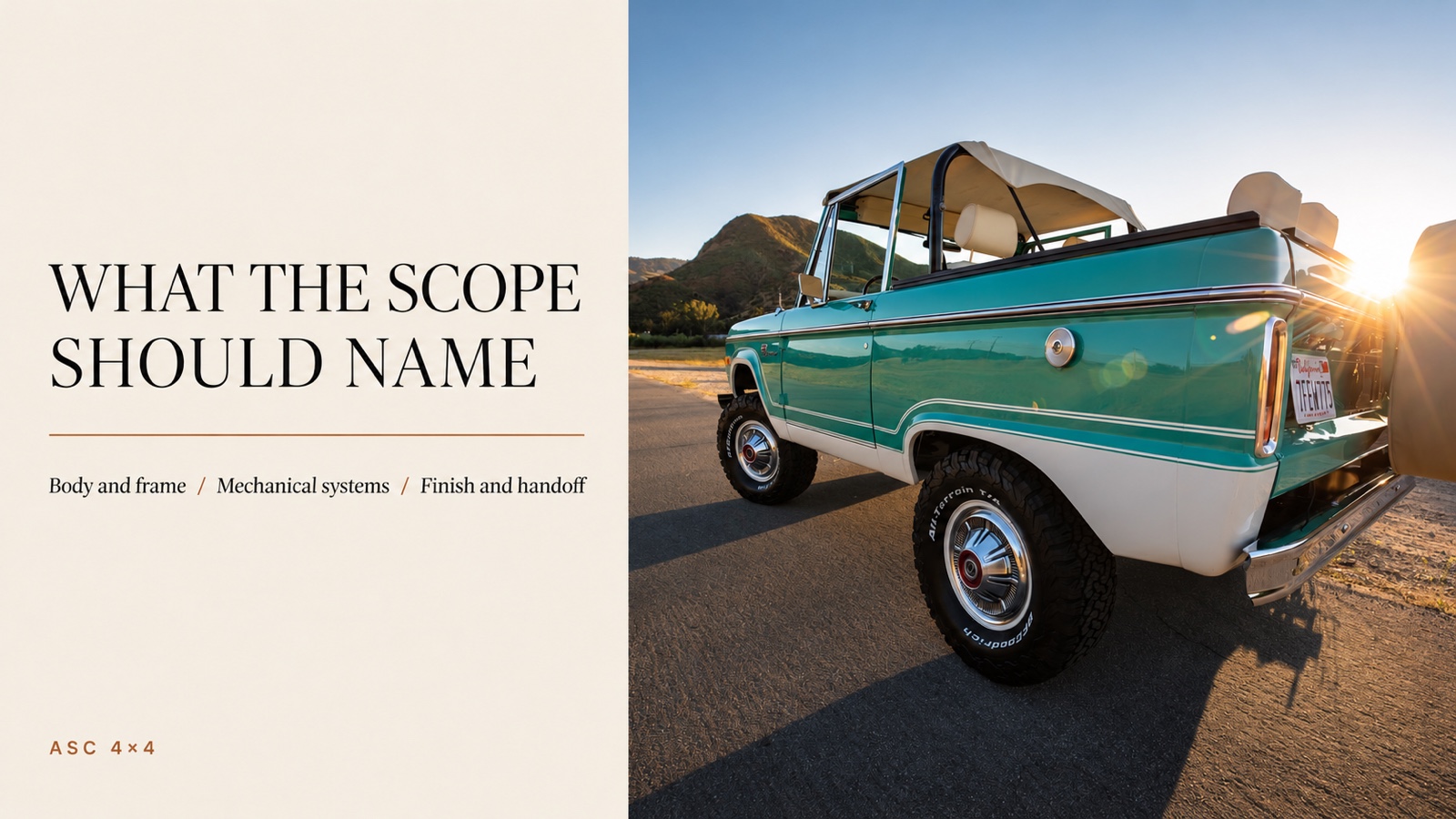
Questions to settle before the body comes off
- Is the goal a stock-minded restoration, a restomod, or a custom build?
- Which original components and identifying details must be preserved?
- What finish standard applies to metalwork, paint, interior, and assembly?
- Which systems are being rebuilt, replaced, or retained?
- How will newly discovered work be documented and approved?
- What records, parts lists, and photographs will be delivered with the vehicle?
If a proposal uses “frame-off” as the whole description, ask for the scope behind the phrase. The quality of a build lives in its standards and decisions, not in a label.
Is a frame-off restoration always necessary?
No. The right restoration depth depends on the Bronco’s condition and the intended result. A frame-off build is one way to reach areas that are difficult to assess with the body installed. It is not a default requirement for every project, and it does not replace a clear repair and finish specification.
Does frame-off mean every part is new?
No. Components may be retained, rebuilt, replaced, or upgraded according to the project brief. The scope should identify those choices rather than leave “frame-off” to carry them implicitly.
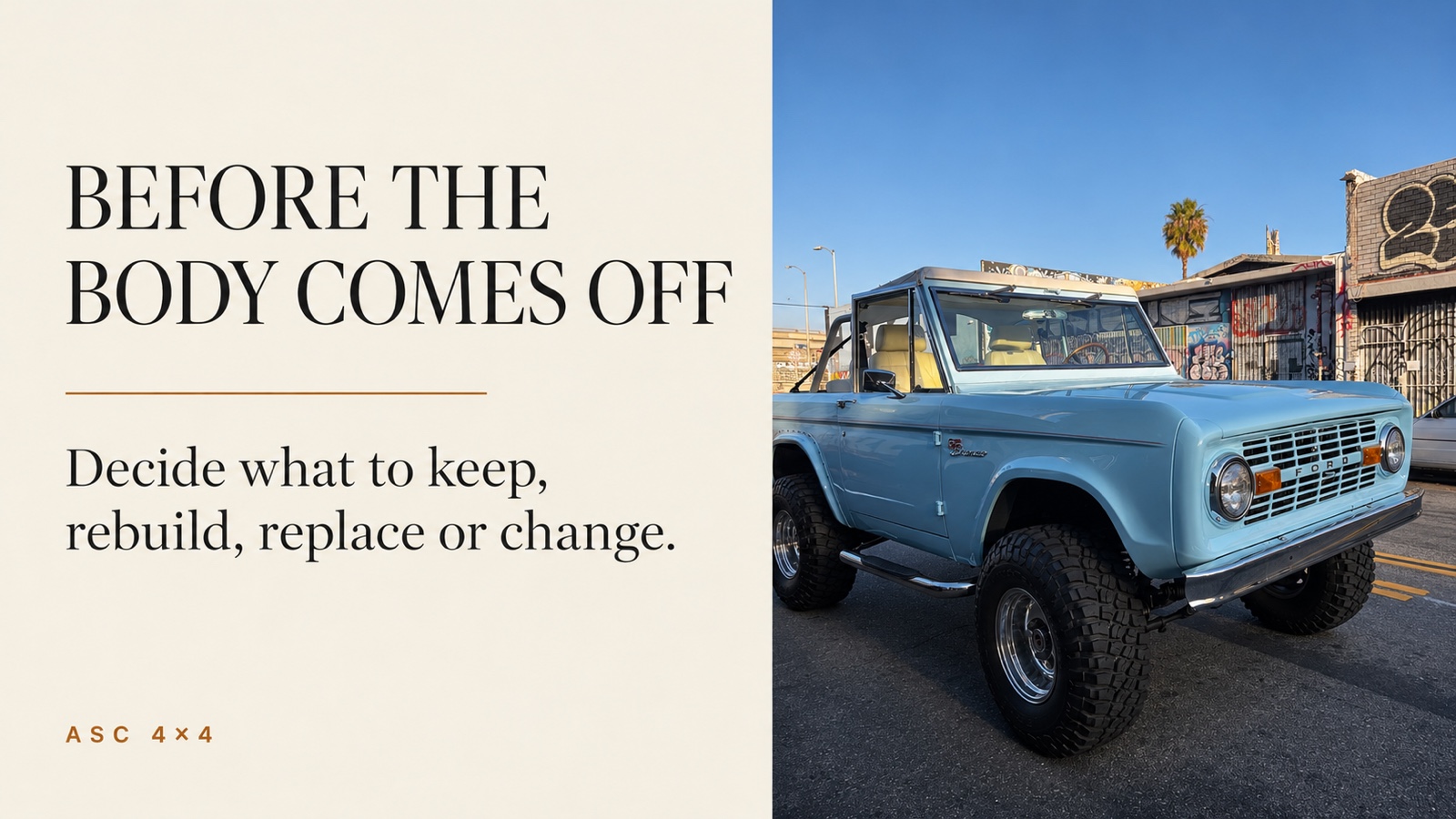
Can a frame-off restoration include modern upgrades?
Yes. A vehicle can receive a frame-off restoration and also be built as a restomod. “Frame-off” describes access and disassembly; “restoration” or “restomod” describes the desired character of the finished vehicle.
ASC 4×4 in Los Angeles builds vintage Broncos through full restorations, restomods, and custom projects. Bring the Bronco’s year, current condition, and the result you want. Call (310) 396-6341 or start a conversation through ASC 4×4.